The Handy Recovery Scholarship for Students Who Can Explain Technology Clearly

When most students think about scholarships, they usually imagine awards given for high grades, athletic achievements, community service, or other personal accomplishments. The Handy Recovery Scholarship takes a slightly different approach.
Instead of focusing solely on academic records, it invites students to explore practical technology topics through writing and offers a one-time $1,000 award to a selected student who submits an original essay on one of several technology-focused topics. Curious whether you’re eligible? Below, you’ll find the scholarship requirements, available essay topics, and the steps needed to apply.
What Is the Handy Recovery Scholarship?
Data recovery is not exactly the type of technology topic that makes headlines. Ask yourself about technology, and most will probably mention artificial intelligence, cybersecurity, software development, or maybe robotics. Data recovery rarely makes that list.
Which is a little strange when you think about it, since students spend years creating digital work – essays, presentations, research projects, notes, photos, videos – most of it ends up on a laptop, a phone, a cloud account, or an external drive. Then one day a file disappears, a storage device fails, or something gets deleted by mistake. Suddenly, a subject that seemed fairly obscure becomes very relevant.
The Handy Recovery Scholarship follows the same idea. Instead of asking applicants to write about a broad academic subject, it asks them to focus on topics related to data storage, backups, cloud services, and data recovery. The winning submission receives a $1,000 scholarship, but the program is also meant to get students thinking about technology that most people use every day without paying much attention to it. Until something breaks, of course.
Who Can Apply?
Not every scholarship is open to every student, so it makes sense to check the eligibility requirements first.
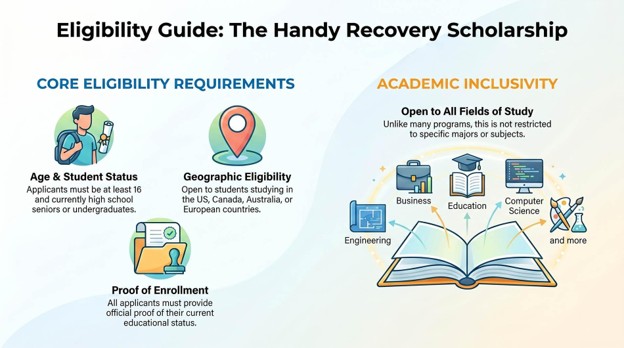
You may apply for the Handy Recovery Scholarship if you:
- Are at least 16 years old.
- Are currently enrolled as a high school senior or undergraduate student.
- Study in the United States, Canada, Australia, or an eligible European country.
- Can provide proof of your current educational status.
Unlike some scholarships, this program is not limited to a specific field of study. Whether you’re studying computer science, education, business, engineering, or another subject entirely, you can still apply as long as you meet the eligibility requirements.
What Do You Need to Do to Apply?
The application process revolves around a single essay written in English. Applicants must choose one of the topics provided by Handy Recovery Advisor and submit an original essay between 800 and 1,000 words.
Recent scholarship topics have included:
- How AI may impact the data backup industry
- How modern storage impacts data recovery
- What data recovery tools can and cannot do (common myths and limits)
- How cloud syncing and modern devices can increase data loss confusion
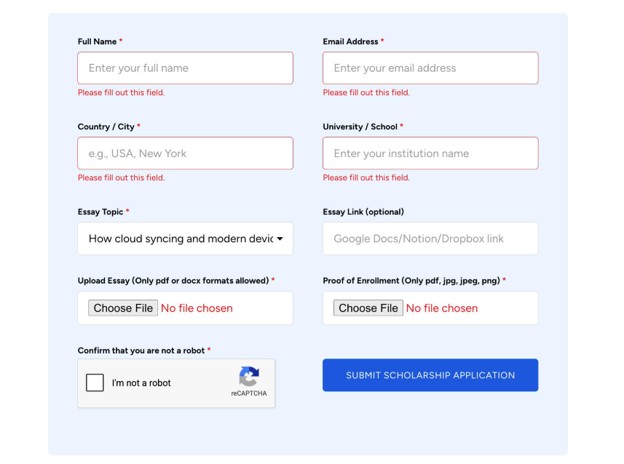
Once your essay is complete, you’ll need to submit it through the application form on the Handy Recovery Scholarship website. Along with the essay, applicants are asked to provide basic personal information, such as their name, email address, educational institution, and country of residence. Proof of enrolment, such as a student ID card or transcript, must also be included as part of the application.
Applications for the current scholarship cycle are accepted until October 1, 2026 (11:59 PM UTC). The winner is expected to be announced on October 31, 2026.
Why Give It a Try?
A chance to win $1,000 is already a good reason to consider applying. But according to the program rules, the winning essay may be published on the Handy Recovery Advisor website with full author credit.
For students building a portfolio or planning for future internships and job applications, having published work attached to their names can be a nice bonus. If the topics sound interesting and you meet the eligibility requirements, there is little downside to giving it a try!
Handy Recovery Advisor operates within the space of Data Recovery and Data Management. The website publishes guides, software reviews, and research focused on data recovery and related technologies.