Baking Cookies with Kids: The Surprising Skills They Build at Every Age
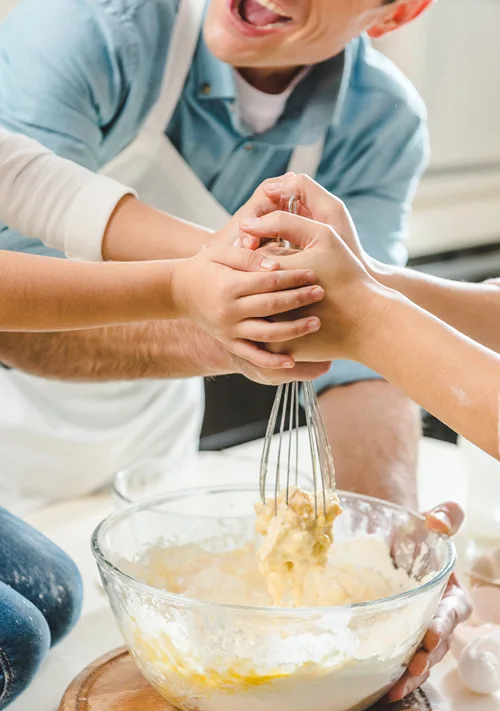
Flour on the counter. Egg on the floor. A five-year-old who insists the sugar was measured correctly. Most parents see a mess. A cookie-baking session can still be one of the most useful things you do with a child on a Saturday afternoon.
This is not about raising a pastry chef. Mixing dough can build math reasoning, fine motor control, patience, reading comprehension, and confidence at the same time. The skill being practiced changes with age, which is worth knowing before you hand over the measuring cups.
Why the Kitchen Works When a Worksheet Doesn’t
Kids learn in context. Numbers on a page can feel abstract. A cup of flour that is slightly off can change the batch. That real result gets attention in a way a worksheet often does not.
Cooking with children can support several skills at once: math, science, language, motor development, and social skills. The University of Nevada, Reno Extension notes that following recipes can help with counting, measuring, sequencing, sorting, and fractions. Reading the steps also builds vocabulary and print awareness.
The lesson changes by age. A three-year-old pouring flour is working on grip and coordination. A ten-year-old doubling a recipe is doing real proportional math. Same kitchen. Different skill.
The Age-by-Age Skill Framework
Think of baking tasks as a ladder. Let children own the rungs they are ready for, even if the bowl looks messy.
| Age range | Best baking tasks | Primary skill built |
|---|---|---|
| 3 to 5 | Pouring pre-measured ingredients, stirring, pressing dough | Fine motor control, sensory processing |
| 6 to 8 | Measuring dry and wet ingredients, reading simple steps | Basic math, sequencing, reading comprehension |
| 9 to 11 | Timing, temperature awareness, halving or doubling recipes | Fractions, proportional reasoning, responsibility |
| 12 and up | Choosing recipes, adapting ingredients, troubleshooting | Problem-solving, self-direction |
The table is a starting point, not a rule. Some seven-year-olds can crack eggs without help. Some eleven-year-olds still need coaching with a timer.
Math Is the Secret Ingredient
If a child has struggled with fractions, the kitchen can make the idea concrete. A half-cup next to a quarter-cup next to a full cup shows that fractions have size and weight.
The National Association for the Education of Young Children has long connected everyday activities like measuring and comparing quantities to early number sense. Measuring ingredients teaches fractions and volume. Doubling a recipe reinforces multiplication. Asking a child to turn a 12-cookie recipe into a 36-cookie batch is a math problem disguised as dessert.
Hands-on kitchen work often reaches children who do not show the same number sense on paper. Meaningful context matters.
Creativity, Confidence, and Decoration
Once the cookies come out of the oven, the task changes. The measuring is done. Now the child has an open canvas: icing colors, sprinkle patterns, simple shapes. There is no single right answer.
Choosing toppings and flavors gives children a chance to express preference and try ideas. This is also the easiest place for a parent to step back. They do not need guidance on which sprinkles go where. That small act of backing off is what lets confidence form.
Following Directions Without a Power Struggle
When a parent gives an instruction, it can feel like a request. When a recipe gives an instruction, it belongs to the task. The dynamic is different.
If the dough is missing a key step, the cookies show it. That consequence is clearer than a lecture. A child who sees that skipping a step changes the result may read the next set of directions more carefully, in the kitchen or at school.
Using Ready-to-Bake Dough to Lower the Barrier
Not every session needs to start from scratch. Ready-to-bake cookie dough removes the hardest part for new bakers and lets younger children focus on portioning, spacing, decorating, and watching the cookies change in the oven. It also shortens the session, which matters when patience is limited.
That is one reason cookie dough remains a common school fundraising product. Families recognize it, and it is something they can actually use at home. ABC Fundraising Cookie Dough is one example of a ready-to-bake option that school groups sell because parents can turn the purchase into a kitchen activity rather than another item that sits unused.
If your child’s school runs a cookie dough drive, treat it as a baking session, not only a sale. Let the child portion the dough, set the timer, and decorate. The fundraiser becomes a real kitchen lesson.
A Practical Checklist Before You Start
- Pick one skill to focus on. Do not try to teach fractions, motor skills, and recipe reading in the same half hour.
- Set up ingredients first. Pre-measure for kids under six so the session does not stall.
- Let them read the steps out loud. Even early readers can follow a simple recipe with help.
- Accept imperfect cookies. Uneven shapes are fine. The process is the point.
- Ask one question after: “What would you do differently next time?”
The cookies are the product. The skills are the point. The next time you bake together, your child is likely to remember both.