Category: Safety | Internet Security

How to Report an Email as Phishing
Report Email Phishing

Hopefully when you received a phishing email regarding one of your online accounts you didn’t click the link and try to login. This is how hackers attempt to gain access to your account without you knowing. If you did login, immediately close your browser. Then, re-open it and go to the proper sign page through your browser and change your password.

We all get phishing attempts via email but we can do more than just educate ourselves on how to prevent being tricked. Before you delete the phishing email report it to the proper website that the phishing email is trying to access. These same companies have cyber security people that you can forward the email to.  Simultaneously you can report all phishing attempts to the Anti-Phishing Working Group at [email protected]

When concerned about possible virus infection of your computer perform a malware scan. To clarify, most phishing attempts are not created to infect and take over your computer.  Rather, the goal of phishing is to learn your account login details so they can steal your personal information.

Below are some of the more common companies that identity thieves try to mimic. These are just examples and there are many others.  If you don’t see the contact information below for the company you are looking for, simply Google it safely at the top of our website. For example, if the phishing attempt is in regards to PayPal, Google “Report PayPal Phishing”.  Often, you will find an email address posted that you can forward the phishing email to.

Report as Phishing to These Companies

In addition to forwarding phishing emails to appropriate companies and to the Anti-Phishing Working Group, you can also report the phishing link to Google but be careful. Don’t open the link in a browser, simple right click the link and select copy hyperlink. Cut and paste that link into the Google submission form and submit. Then, delete the phishing email. 

Here are a few examples of the top companies whose account holders are the top targets.  These companies want you to forward phishing emails to them so they can prevent future fishing attacks.

PayPal

PayPal is a top target of phishing because it gives thieves direct access to your money. If if you don’t currently have funds in your PayPal account, people with access can make payments out of a bank account or credit card that you have linked to. Report PayPal phishing attempts to [email protected] which can also be accessed on their PayPal suspicious activity.

If you have clicked a bad link or are worried about whether your account has been compromised change your password immediately. Learn more about how PayPal deals with account fraud.

DocuSign

Often, phishing links for DocuSign will go to Google Docs.  This may appear legitimate because it is using the Google domain but really it is someone with a Google account hosting a bad doc to gain your personal information.  Be proactive and report suspicious emails to DocuSign’s security team at [email protected]. If you feel the security of your account is at risk, contact DocuSign customer support.

Below are some tips to help spot the difference between real and spoof DocuSign emails: 

All URLs to view or sign DocuSign documents will contain “docusign.net/” and will always start with https.  All legitimate DocuSign envelopes include a unique security code at the bottom of notification emails. If you do not see this code, don’t click on any links or open any attachments within the email.

For the latest DocuSign security and system performance information, visit the DocuSign Trust Center

Report Facebook Phishing

Facebook is one of the largest website in the world with over 2.7 billion active users.  They have taken great strides to protect against phishing and promote that they take seriously all phishing reports when you forward the email to [email protected].   They have also set up security tools to prevent outsiders from signing into your account.  Like many online accounts they recommend and offer ‘two factor authentication’.  They will also email you of suspicious login attempts when you set up to receive unrecognized login notifications.

Netflix

Because Netflix is such a popular streaming service these days, it’s one of the more popular targets for phishing. Netflix states that they will never ask you to click a link to enter personal information about your account. Even if you are not sure the email you receive is a phishing attempt, report it to Netflix by forwarding the email to [email protected]. If you want to check your account to see if something is wrong with your billing, for example, go to Netflix.com directly or via a bookmark you’ve already saved to log into your account.

Here is a classic phishing email that Netflix would never send to you.

Dear user, We’re having some trouble with your current billing information. We’ll try again, but in the meantime you may want to update your payment details.

Most phishing emails feature proper links to the company at the bottom of the email, such as the Netflix support page or contact page. This is to trick you into thinking it’s legit. However, the link in the middle of the email goes to a different website.

Banks and Credit Card Companies

You may only have one bank account and one credit card. So when you receive an email from a bank that you don’t have an account with, it’s easy to ignore. You may even be thinking, why would they send this to me? Well, cyberthieves use spam internet servers to sent the phishing email to millions of people because they know at a percentage of those on the list will have an account with a particular bank.

This is why you will sometimes get an email that looks like it’s from your bank. Don’t worry, the scam artist probably doesn’t know you have an account with a certain bank. You are simply one of millions of people on a list.

Chase is one of the top banks that phishing emails try to mimic.  But really, there are too many banks and credit card companies to list, so it’s wise to be wary of any email from your bank.  Any information you need to know about your bank account will be within your account, so just go to your regular bookmark in your browser to login or to go Google and search for your bank.  You never have to worry if you always go directly to your bank to see if there are any important notifications for you.  Or just call you bank. 

To report a phishing email to your specific bank, search for your financial institution on Google by typing in your bank name followed by the keywords ‘report phishing email’.

Report as Phishing to Apple

Apple is a big one.  Your user name and password gives phishing attempts access to your iCloud account where all of your files are stored, including your contacts and pictures.  If you see any email that looks suspicious report it to Apple by forwarding the email to [email protected]Apple will never ask you to verify your identity using your password.  They also recommend to protect your Apple ID by using two-factor authentication.  This security measure is available with many online accounts where a code is sent to you via text or email to complete your login.  This means that even if hackers gain access to your user name and password and try to log in, you will get a notification, but unless they have access to your phone, they can’t gain access.

Courier Companies and Shipping Outlets

Couriers include companies like Fed Ex, UPS, DHL Express, Purolator, and USPS.  Shipping may also come from online stores who use couriers, such as Amazon and Target.  The email may say something line “We are having trouble delivering your shipment!”  If you are expecting a shipment, you will immediately be concerned.  If you are not expecting a shipment you may wonder why you are receiving a product when you didn’t order anything. This is probably a phishing email, but even if it isn’t look closely at the email.  It’s always best not click any links and simply go to your account directly through your browser.  If you don’t have an account with a specific store, such as Walmart, then you know it is more than likely a phishing email.  Report it to the company concerned then delete the email.

Amazon

Many people have an Amazon account.  You may get an email from Amazon asking for your to login to correct a problem.  This is more than likely phishing.  Do not login using the link in the mail. Go directly to your Amazon account from your browser to see if there are any issues.  Amazon also uses couriers and the same safety rules apply.  Amazon usually notifies online shoppers that a real shipment has been delivered to their door, but they will never put a link in that email and ask you to check on your shipment.  Forward all suspicious emails to Amazon at [email protected]

Additional Contacts to Report Phishing

If you have scrolled down to this bottom of this email looking for a company that is not listed above, below are are few safe links or email addresses to report a phishing attempt to that company. Reporting phishing is important so that collectively, we can work to shut down the hackers and scammers who are trying to steal personal information from millions of account holders around the world.

A Quick Review of What to Do When you Receive a Suspected Phishing email.

  • Don’t click any link to login to your account.  Go directly to your account via your browser bookmark or by searching for it on Google.  If you don’t have an account related to the email, it’s probably a phishing attempt and you have nothing to worry about.
  • Before deleting the phishing email, forward the email to the company the identity thieves are pretending to be.
  • Report the phishing link to Google but be careful how you copy the link to paste it on Google’s reporting page. Never click the link.  Instead, right click on the link to copy the hyperlink. Then delete the email.
  • When you forward a phishing email to any company, cc the email to the Anti-Phishing Working Group at [email protected]

Here are additional emails not written about above that you can report phishing emails to:

Report Email as Phishing to Gmail

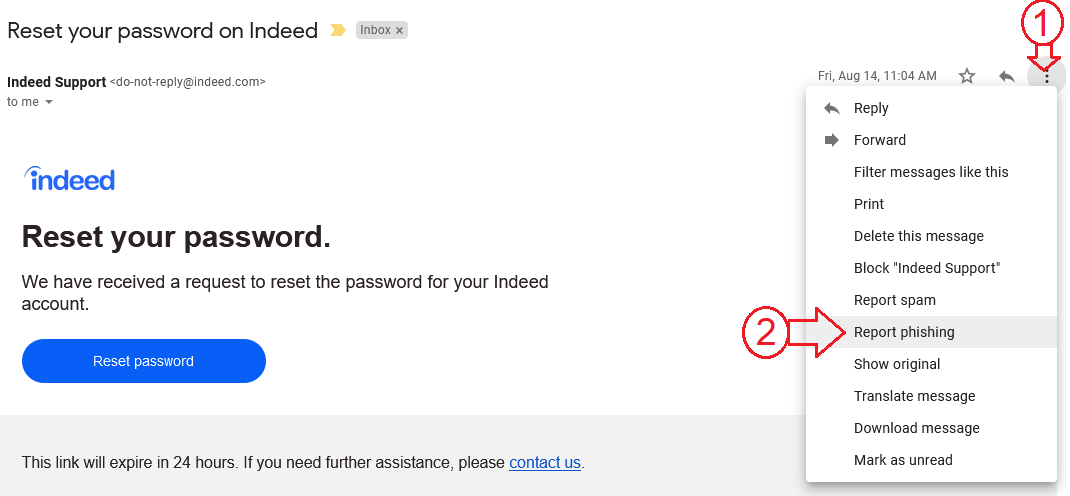
This image below shows you how to report amy phishing attempt that is sent to your Gmail. To access this, you need to be signed into the web version of your gmail account. Reporting these emails will help reduce phishing and spam emails to your Gmail, but you should also report emails to the company being spoofed.

To report phishing to Gmail follow the steps below.  1) On an open email, select the drop down menu on the top right. 2) Select Report Phishing.Report Email Phishing to Gmail
About Google Account Security:  Since Google accounts only have one login to multiple website, including YouTube and the multiple apps within Google for Education, consider setting up Two Factor Authentication to protect your account.

Additional Resources

Make sure your computer is not infected with Malware because you clicked a phishing email, scan your computer and protect against future attacks.

Learn more about Phishing and the new ways hackers use to steal peoples personal information.  Read about Smishing (Text) and Vishing (Phone) Scams.

Share This Article

10 Tips for Safe and Efficient File Sharing

File Sharing Safety

File sharing is the process in which digital media is shared among devices. The art of file sharing is not a new thing as it began in 1967 when Alan Shugart invented the floppy disk. This technology has evolved over the years from people being able to share a single file to multiple ones by one click of a button.

Currently, there are no limits on the number of files that you can share. The process involved is both simple and straightforward.

Making Use of Safe Technological Tools

In recent years, there have been advancements in technology that now allows you to zip files and share them. There are companies that pioneer in the provision of tools for compressing, zipping, and achieving files. The beauty of using such tools is that they will reduce the size of the document without tampering with the format and appearance. They also have an option to input security measures so that files can only be accessed by authorized people alone.

But, what are the benefits of file sharing? When done safely, it:

  • It is affordable which allows teams to have access to relevant information at a low cost.
  • The process is efficient as the technology available allows you to share files promptly.
  • Based on the service that you are using, files shared can be accessed from any location.
  • It fosters collaboration especially if you are using cloud computing that allows users to edit the information online.

Currently, there are numerous ways in which you could share files safely.  It’s simply one more way to protect you, your computer and your family online.

Below are 10 tips on how to share files safely and efficiently:

1. Avoid emails

Emails may be convenient but they are not the best when sharing documents with confidential information. These platforms are prone to hacking which could result in confidential files landing in the hands of authorized personnel.

2. Update your security software

Often people forget to update their software which leaves them vulnerable. Hackers know this and tend to take advantage of systems that are not updated.

3. Encrypt with passwords

Technology has made it possible for people to incorporate passwords on files that they do want people with prying eyes to see. To ensure that a document is not easily accessible, you need to encrypt it with a complicated password that has upper and lower cases as well as symbols and numbers. When you leverage encryption, you will significantly reduce the penetrating power of various cyberattacks.

4. Change passwords often

It is recommended that you change your passwords often preferably every month. Because it can be difficult to remember to make these changes, you need to note down the dates when passwords need to be changed.

5. Use secure connection

Remote workers are among the people who are fond of sharing information among themselves. Suppose you work away from the office, you need to ensure that your connection is secure before sharing any files. Be extra careful if you are using a public WiFi.

6. Refrain from suspicious downloads

The rule is that whenever you are sharing files using digital platforms is that you never download files that you do not trust. Hackers can incorporate viruses, spyware, and adware on files to gain access to your system. Thus, you should never open downloads that you do not trust.

7. Double-check inbox emails

Working from home will have you receiving a ton of emails from various stakeholders, customers, and colleagues. It is always safe to check the sender of the email several times before opening any attachments that come with it. Sometimes a sender may appear legitimate, your job is to look keenly so that you protect your files and digital devices.

8. Utilize safe file-sharing programs

There exist programs that you can use to share files with colleagues. Among them are Enigmail., pCloud, Resilio., SpiderOak., and Signal. These programs should have features such as web editing, remote file access, and file locking as well as mobile access.

9. Refrain from clicking links

Do not make it a habit of clicking links that come with files that you receive. If you are in doubt, you should hover around the link a couple of times before clicking it. When your gut tells you that you should click a link, you need to listen to it.

10. Avoid USB drives

Flash disks and external hard drives are not the best tools to share files with them. Given their size, they are bound to get lost and are easy to steal as well. Suppose, they fall in the wrong hands, you lose valuable data.

Conclusion

File sharing is one of the most important technologies we have. It enables teams to work together onsite and remotely. However, this process is prone to the risk of hacking hence the need to share files securely.

Share This Article

Gamer Security | Protect and Play Safer

Gamer Security

Got a kid that loves to game? Or maybe you are an avid gamer yourself. Have you thought much about gamer security? There has been plenty written about protecting your home computer with an anti-virus program, but what about increased performance while gaming?

Account hacking, phishing, malware, ransomware, and social engineering are all potential cybersecurity threats of online gaming.  We’ll explore what you can do to protect yourself while gaming, plus we’ll offer solutions to improve performance without compromising security.

Online Gaming Security

When a gamer signs up for a gaming platform, they are often asked to accept terms and conditions regarding privacy policies and data usage.  Game developers typically ask for a variety information, such as names, usernames, email addresses, countries, games played, dates of birth, and languages.  But some also gather more sensitive information, including addresses and credit card details.

While this data collection helps improve the gaming experience and monitors for cheating, it’s important to be aware of how developers manage your personal details.  The more of its user data a company holds, the greater a risk when there is a breach. This is where several cyber security threats that we’ve mentioned come into play.

Here are a few steps gamers can take to protect against the dangers while gaming.

Review Privacy Policies.

Understand how information is collected and how it is stored.  When kids are playing online, it is up to the parent to be aware of the policies on any gaming platform their children are using. If possible, gamers should opt out of any non-essential data collection.

Secure Accounts

Enable MFA when possible and use robust unique passwords for each account.  Consider using a password manager to create and store them.

Use Secure Wi-Fi

Use a secure network with a strong password and updated security settings when gaming. Avoid publish Wi-Fi and consider using a VPN for added protection.

Stay Up to Date

Install updates when promoted to protect against know vulnerabilities.  This applies to both the games and devices.

Protect Personal Information

Limit information share with other players. Unlink social media accounts and keep profile visibility private to reduce the risk of exposing personal information to cybercriminals.

Remember the SLAM Method

With any suspicious or unsolicited messages, closely examine the Sender, Links, Attachments, and Message content to avoid falling for scams.

Better Gaming Solutions

Now, let’s explore gaming performance issues that tempt users to compromise their safety.

Issues with Anti-Virus Software

There is a problem that arises when the anti-virus is turned off completely because it interferes with the online gaming experience.  McAfee Gamer Security solves the debate within families regarding how much security one can compromise in order to maintain computer performance while playing.  McAfee created Gamer Security as a complete gamer software solution.  Security + Performance.

This gamer security software was not designed to merely prevent a decrease in gaming performance while staying protected online, the software boasts a faster, more quiet, and safer gaming experience thanks to cutting edge performance enhancing technologies.

Game Boost Engine

Some anti-virus programs have long had a problem with bogging down computers while you are trying to other tasks.  Gaming is more than a task.  It’s be huge drain on an operating system and requires a fast internet connection.  It also craves every ounce of CPU and RAM it can squeeze out of your operating system.  The McAfee Gamer Security program works to get more performance out of your operating system and ensures your games stay prioritized over applications running in the background.

All of this increased speed happens without you having to turn off the anti-virus program that is part of the software.  Slowdowns are bound to happen so this gamer software promises to resolve those slowdowns quickly so your game is not held back from working properly.  This is especially important when playing online with a team.

App Manager

The app manager within McAfee Gamer Security gives you control to kill or de-prioritize resource heavy apps.  While maintaining operating system performance, the software automatically saves stats from your last 5 game sessions which you can look at later.  Settings are customizable, providing intuitive control over system optimization and pop-up suppression is readily available. You can also tweak the software’s multiple settings as desired.

McAfee Gamer Security helps you achieve a smoother overall experience on your PC, from everyday performance gains thanks to the low impact MicroAV engine to the FPS stability. This also results in smoother game play delivered by their Game Boost technology. 

Pricing

Some users may not like the annual price tag on this software.  Not that it’s unusually priced above other anti-virus type programs, but the annual subscription for Game Security is only for one computer.  This may not be a problem as there may only be one gamer in the household in need of online protection, while increasing speed and customizable performance.

Gamer Online Protection with Enhanced Performance

Not to be infused with parental control software that filters content, McAfee Gamer Security is a software download that allows gamers to enhance their computer performance while stay protected with anti-virus protection.  It’s a vital tool in to help players engage safety with fellow gamers.

Gamer Security System Requirements

To operate the Gamer Security software you must have Microsoft Windows 10 version 1809 (Oct 2018 update) or later.  If you already have Windows 10 and are unsure of what version is running simply update to the latest version.  It’s a good idea anyway to turn on automotive updates for Windows to ensure your systems is always secure.  The hardware needed on your computer is 2 GB RAM | 500 MB free drive space | 1 GHz Processor.  A high-speed internet connection is recommended.

How is it faster? When McAfee did tests of their gamer security software compared to both traditional and built-in AV they found:

  • A faster boot.
  • Faster shutdown.
  • Faster standby suspend.
  • Faster suspend to hibernate.

Related Resources:

Looking for online games you can play on your PC, Mac, or Tablet?  Check out our safe online game search tool.

Share This Article

9 Proven Ways To Enhance Your Email Privacy!

9 Proven Ways To Enhance Your Email Privacy

Even though WhatsApp, Facebook Messenger, Instagram, and Snapchat among others are the go-to social media platforms for instant communications, we still heavily rely on emails even in 2020. So why does there seem to be little focus on ways to protect our email privacy?

Afterall, we use emails to share our financial information with our accountants, manage online money transfer services like PayPal, and even use it to create all of our social media accounts. In a sense, our personal lives are linked to our email addresses.

Despite being such a major part of our life and the fact that approximately 320 billion people are using it, email remains as one of the least secure means of communication. Believe it or not, email technology is still based on protocols that can’t cope up with modern online security threats.

Getting your email hacked might not seem like a big deal for kids, but for adults, it can be an absolute nightmare.

Keeping this in mind, in today’s informative blog post, I’m going to talk about why email privacy is so important, share with you some real-world email hacking case studies, and also tell you 9 proven tips to enhance your email privacy.

Why Email Privacy Matters?

Think about it for a second, everything you do online is connected to your email address. Whether it be online banking or something as simple as signing up for any online service, you’ll have to provide an email address to get started. Once you get registered, you usually get your account details such as username and password emailed back to you.

If a hacker gains access to your emails, all hell can break loose. About 92% of malware is delivered through emails. That’s an alarming figure.

If a hacker gains access to your account, they can obtain sensitive information such as account credentials, personal information, and even steal your identity.

Now you must be thinking, how on earth can someone read my emails when no one knows my password?

Well, unlike the messages we send over WhatApp and other end-to-end encrypted messaging services, emails go through numerous servers before reaching their destination.

Whenever an email passes through an intermediary server, multiple copies of it are stored. While one server might be difficult to hack, others might not be. That’s how your emails get compromised.

Think I’m making this up?

Well, you can enter your email address on haveibeenpwned.com and check whether anyone has compromised your privacy.

Anyways, if you still have doubts, let’s check out some real-world use cases where people have actually lost a ton of money simply because their email addresses got hacked.

Real-World Email Hacking Cases

I’m going to share with you two actual cases that resulted in the loss of thousands of dollars simply because some hackers managed to gain access to the email accounts of unsuspected victims.

Case #1 – $47,500 Stolen From a Pensioner

A pensioner in Brisbane Australia bore a loss of $47,500 when he became a victim of an identity theft case. A hacker managed to hack into the victim’s account and send a series of convincing emails to the advisor managing his pension funds.

The hacker requested to deposit $90,000 to an overseas bank account as his daughter desperately needed money. The advisor got convinced and sent over a Pension Payment Request form telling the hacker that only $47,500 can be withdrawn.

The hacker filled in the form with all the details stolen from the client’s email account and told the adviser not to call him as he’s attending a funeral.

The advisor respected the client’s request thinking it was genuine and processed the withdrawal request right away. Till the real client could manage to explain that his email account got hacked a few days ago, the funds were already transferred to an offshore account.

Case #2 – Barely Dodged an Email Fraud of $260,000

Another financial adviser based in Australia was also targeted by a hacker, however, she managed to dodge a fraud of $260,000.

A hacker emailed her from her client’s email address that got hacked, requesting her to change the email address to a new one. The new email address only had one letter missing — “g”.

The hacker then sent an email from the new email account telling the advisor to deposit $260,000 in an offshore account because they wanted to buy some property. The email seemed totally legit, however, since the amount was quite substantial, the advisor wanted to talk to the client personally for authenticity reasons.

However, the real client was unreachable over the phone, and the transaction got delayed. In desperation, the hacker contacted the adviser via a phony contact number that was associated with the new bogus email address.

However, upon getting in contact, the adviser quickly figured out that the person on the phone was not the real customer judging from the accent, and refused to process the request.

9 Tips to Enhance Your Email Privacy

So by now, you must have an idea of how a hacker can take over your life if your email address gets compromised. But it’s not the end of the world. Now, we’re going to look at 9 proven easy tips to enhance the privacy of your email accounts.

Tip #1 – Use More Than One Email Address

You should never rely on just a single email account for work and personal use. Always use two different email accounts to segregate your work mailbox from your personal mailbox. This will ensure that you’re not putting all your eggs in the same basket.

If you want to take this strategy to another level, you can create different disposable email addresses when signing up for any service online. This way, you’ll never risk your personal information.

Tip #2 – Use Strong Passwords

Probably the most basic reason why most people lose their email accounts is that they use weak passwords. Passwords like your name followed by a sequence of numbers (John12345678) are really easy to crack.

With your password compromised, a hacker can freely go through your emails, piece your personal information together, and then wreak all sorts of havoc.

An easy solution to this problem is to use strong lengthy cryptic passwords. Use a lot of uppercase and lowercase letters along with numbers and special symbols to make your password uncrackable. A password like this: !.v[L2,m=nVhpPJ<:Ub<gQ5A, would be impossible to compromise.

Tip #3 – Don’t Share Your Email When You Don’t Have to

This seems pretty self-explanatory, however, you’re often going to find people linking their email addresses in their social media bios. We’re all guilty of it. Another mistake that we all make is that we tend to provide our real email address when signing up for services that don’t really require email confirmations.

By limiting where we share our email address, we can prevent hackers who are constantly on the lookout for new victims from compromising our email account’s privacy.

 Tip #4 – Enable Two-Factor authentication

In addition to using an insanely strong password, it’s often a good idea to use two-factor authentication (2FA). Two-factor authentication ensures that if your password gets compromised, an attacker will still be required to bypass the second layer of security.

Depending on which version of two-factor authentication your email client offers, an attacker will be required to either enter an email address on a secondary device, enter a pin received via SMS or answer a secret question for reinforced privacy.

Tip #5 – Never Email Personally-Identifying Information

Since emails are relatively easier to hack and compromise, you should never share any personally identifiable information such as social security numbers, phone numbers, date of birth, and other sensitive data. This will ensure that you’re not providing any information that can come back to haunt you in the future.  Another available resource where you can check if your data is exposed is from CyberNews and their data leak checker.   It covers the latest leaks from LinkedIn or Clubhouse, just to name two. 

Tip #6 – Use a Secure and Authentic Email Client

If you want to be completely sure that no will be able to read the contents of your emails, you’ll have to ditch mainstream email clients like Gmail for something that’s not generic and actually offers any privacy.

You can go for something like ProtonMail, who have their servers buried 1,000 meters underground in a Swiss bunker. Other noteworthy email clients include Posteo, Mailfence, and mailbox.org.

Tip #7 – Sign Out of Your Mailbox as Often as You Can

This might seem like a cumbersome process, but it can actually enhance the privacy of your email account. Signing out whenever you’re not using your email account can prevent remote hijackers from examining the contents of your mailbox.

Now, I’m not suggesting that you log out of your account every time you’re done emailing someone. Instead, sign out of your email account at the end of your work shift or before going to bed. Especially if you’re using someone else’s computer.

Tip #8 – Don’t Use Public Wi-Fi

No matter how tempting a free Wi-Fi connection might seem, you should never use one for any sensitive task. Hackers are infamous for setting up malicious hotspots to intercept people’s personal information.

So, if you log into your email account via a malicious Wi-Fi connection, a hacker can potentially take over your email account and steal your sensitive information. This is why you should always use only trusted networks or use a Proxy if connecting to public Wi-Fi is the last option available to you.

Tip #9 – Use a Recovery Email Address

The last and final tip I have for you is to always set up a recovery email address in case something goes wrong. This way, if someone manages to take over your account and exploits you, then you can simply change your password via the recovery backup email address and regain control of your email account.

Wrapping up!

So this wraps it up. I hope you now have an idea of why you should start taking the privacy of your email accounts seriously. If you religiously start following the 9 tips I shared with you in this blog post, you can greatly enhance the privacy of your email account.

After all, it all comes down to you. You’re the only one who can put in the effort to and safeguard the privacy of your email account. If you found this blog post informative, do consider sharing it with your friends and family.

Read more about how to protect your email privacy by preventing identity theft through phishing emails.  You can also make the internet more safe by reporting phishing.

Share This Article