Category: Parenting

Teaching Children to Take Responsibility for their Possessions

Teaching Children to Take Responsibility for their Possessions

Though it’s developmentally normal for children to lose their belongings, as a parent, you may be tired of almost constantly replacing or hunting down lost items. It’s never too late to start teaching your child to actively take responsibility for their possessions – and it may save you a lot of money and time down the road.

If you are considering giving your child a brand-new tablet or their first smartphone, you may be wary of trusting them with such a big (and expensive!) responsibility. In this article, we will discuss the reasons children are so prone to losing their things, how you can mitigate it, and how to instill responsible habits that your child will carry with them their whole life.

Why Children Lose Things

Children lose things for a variety of reasons, and it’s important to understand the root causes to help address the problem.

One common reason is the simplest: forgetfulness. Children have a lot on their minds, and it can be challenging for them to remember everything they need to keep track of. This forgetfulness can be compounded by a lack of organizational skills, which can make it difficult for them to keep track of their belongings.

Distraction is also a common culprit when it comes to lost items. This is one you can probably relate to as a parent – how many times have you set down your phone while distracted with another task, only to completely forget where you’d put it?

If your child is neurodivergent in any way, they may struggle with keeping track of their possessions as well. Children with ADHD are especially prone to forgetfulness and distraction – talk with your child’s pediatrician to find the best ways to instill responsibility. .

Teaching Children Responsibility

Responsibility is a skill that needs to be taught like any other. Effectively teaching your children to be responsible may seem like an uphill battle, but a few tried-and-true techniques will make it easy.

One of the most effective methods of teaching responsibility is modeling. When you model responsibility by taking care of your own belongings, fulfilling your commitments, and taking ownership of your mistakes, you implicitly teach your children how to be responsible and dependable.

Children learn by observation, and seeing you act responsibly inspires them to do the same.

Another effective method is introducing gradual, low-stakes responsibilities. Assigning tasks such as cleaning up their toys, making their beds, or helping with household chores can help children build good habits and learn the value of their contributions. Give lots of positive reinforcement to make sure the good behavior continues!

Determining Age-Appropriate Responsibilities

Determining age-appropriate responsibilities is a crucial aspect of teaching children responsibility. You want to set your child up for success, not give them an unrealistic challenge.

When it comes to introducing new technology, such as a tablet, smartphone, or laptop, it’s important to consider your child’s maturity level rather than just their age. Some children may be ready for the responsibility of owning and using devices at a younger age, while others may not be ready until they are older.

Before giving your child a new device, ensure that they understand the value and importance of the device, as well as the rules for using it. This includes when it can be used, how long it can be used for, what apps and websites are allowed, and what parental controls are in place. You want to give them clear and explicit expectations for using the device; this makes it easier to enforce boundaries later on.

Some children may not be ready for certain responsibilities, even if they are the appropriate age for them. It’s important for parents to recognize their child’s strengths and weaknesses. For example, a child who struggles with organization may not be ready for the responsibility of owning a small, easy-to-lose smartphone; however, they may do well with a tablet or laptop that stays in one spot all day.

What to Do When Something Breaks

No matter how responsible a child is, accidents happen, and things can break. It’s essential to have a plan in place for what to do when something breaks, whether it’s a toy, a piece of technology, or something else.

One option is to try to fix the item. Parents can teach their children the value of taking care of their belongings by involving them in the repair process and showing them how to fix things when possible.

Another option is to replace the item, either with a new one or a refurbished one. Refurbished technology, in particular, can be a cost-effective and environmentally-friendly option for parents on a budget. Make sure you discuss with your children the financial implications of replacing broken items and involve them in the decision-making process after an item has been broken.

If the item broke due to carelessness or neglect, though, use it as a teachable moment. Your child may have to go without a tablet or smartphone for a few weeks while they earn back the item’s value through chores.

Conclusion

Remember that every child is different and may require different approaches to learning responsibility. Adjust your approach based on what works best for your child, and always work to set them up for success.

It can be frustrating when children repeatedly lose or misplace their belongings, but it’s important to approach the situation with compassion and understanding. By modeling responsibility, determining age-appropriate responsibilities, and setting children up for success, parents can help their children become more responsible and appreciate the value of their possessions.


Share This Article

Indoor vs Outdoor Trampolines for Kids: Pros and Cons

Pros and Cons of Indoor and Outdoor Trampolines for Kids

When selecting a trampoline for your family, you must determine whether you prefer an outdoor or indoor one. Although they are commonly used as outdoor play equipment for children, we will discuss the pros and cons of each option.

Should You Buy an Indoor Trampoline?

Indoor trampolines are a convenient and fun solution for limited outdoor space or undesirable weather conditions. They can provide an opportunity for kids to stay active indoors on days when it’s too hot or cold outside and take up minimal space.

Pros of Indoor Trampolines

Below are some of the advantages of an indoor trampoline:

Safe and Secure

Indoor trampolines are often preferred by people because they are perceived as safer compared to outdoor trampolines. They often have extra-thick padding and are designed to prevent kids from accidentally falling off the edge or hitting the steel frame. Many parents feel safer letting their children play on a trampoline that is indoors.

For example, Vuly trampolines are indoor trampolines with a patented rebounding system designed to reduce impact and provide a soft, cushioned bounce.

Less Maintenance

Compared to outdoor trampolines, indoor ones need minimal maintenance. You won’t have to think about lawn care, trimming foliage, or storing the trampoline during rainy weather. Cleaning an indoor trampoline is easy. Just use a damp cloth to wipe down the surface.

Easy to Install

Indoor trampolines can be quickly and easily set up without any tools or mounting hardware. These trampolines are a great option for people who are short on time or energy and can’t put together an outdoor trampoline.

Cons of Indoor Trampolines

Although indoor trampolines offer a lot of benefits, there are some downsides that you should be aware of, too:

Less Bounce

Compared to outdoor trampolines, indoor trampolines have a softer and more cushioned design which results in a lower bounce. Therefore, kids may not feel the same level of thrill while jumping on them.

Less Durable

If you plan on using a trampoline frequently, it is recommended that you choose an outdoor model since indoor ones are typically less durable. This is because indoor trampolines are usually made from softer materials which can lead to quicker wear and tear. It is essential to be extremely careful and take extra precautions to prevent the trampoline from coming into contact with heat sources, sharp objects or any other potential hazards.

Higher Cost

Consider buying an outdoor trampoline instead of an indoor one to save money. Indoor trampolines are typically more expensive due to their design.

Should You Buy an Outdoor Trampoline?

Trampolines that are meant to be used outdoors are ideal for keeping kids active while providing them with an enjoyable outdoor activity. They tend to be bouncier than indoor trampolines and are generally more resilient.

Pros of Outdoor Trampolines

Below are some of the advantages of an outdoor trampoline:

More Bounce

Outdoor trampolines generally have a lot more bounce than indoor models, which is why they are so popular with kids. This can take jumping to the next level, providing a much more exhilarating experience.

More Durable

Trampolines designed for outdoor use are usually constructed with stronger materials compared to those intended for indoor use. This enhances their durability and reduces the likelihood of damage from prolonged use. Therefore, an outdoor model is the better choice if you plan on using your trampoline frequently.

Less Expensive

If you’re trying to stick to a budget, consider choosing an outdoor trampoline. They’re often less expensive than indoor trampolines and come in many different sizes and styles, so it’s simple to find one that fits your needs without overspending.

Cons of Outdoor Trampolines

The following are some disadvantages of using outdoor trampolines:

Safety Issues

To avoid injuries, it’s vital to set up and maintain outdoor trampolines correctly. Use a safety net, inspect the trampoline regularly, and put it in an area clear of debris and other hazards.

Maintenance

Outdoor trampolines require regular maintenance, such as lawn mowing and trimming bushes. This can be tedious, especially if you have a large backyard. Furthermore, you must put away the trampoline when it rains or snows to prevent damage from moisture.

When purchasing a trampoline, it’s important to think about the pros and cons of indoor and outdoor options. Your budget and personal preferences should guide your decision. While both options can offer many benefits for children, it’s important to carefully consider which type would be most suitable for you and your family.

Share This Article

How to Prepare Your Child for a Spelling Bee

How to Prepare Your Child for a Spelling Bee

Participating in a spelling bee can be a challenging but exciting experience for children. Big prizes and bragging rights await many winners, but a spelling bee can be nerve-wracking if your child isn’t great under pressure or gets nervous in front of others. Preparing for a spelling bee requires practice, dedication, and time, but it doesn’t need to be something to dread.

Here are some tips you can keep in mind when helping your child prepare for a spelling bee.

Start Studying Early

It’s important to begin preparing for the spelling bee well ahead of time. Don’t wait till the night before to start reviewing and studying words! This will ensure you give your child enough time to learn and practice the words but also understand why words are spelled in the way they are.

Start by reviewing the provided word list and identifying words your child may struggle with. Look at the words your child is having trouble with and try to find books or other things they may have read which contain the word. Once they recognize the word and you explain the grammar rules they are having trouble with, test them further until they don’t spell the word incorrectly anymore.

If it’s a bit of a more advanced spelling bee, consider using a random word generator. This is a great way to expand their vocabulary and help them learn how to spell words they may not have come across before in their regular coursework.

Develop a Study Plan

Once you have identified the words your child needs to study, develop a concrete plan. Set aside a specific time each day for spelling practice and use a variety of study methods such as reviewing flashcards, writing the words repeatedly, playing online spelling bee games, and using them in sentences.

Review the words out of order to keep your child from simply memorizing letters, too. There’s no telling what words they will be given on their turn or what order the words will be read out in, so try to keep them from becoming too complacent.

Incorporate Assessment

Set up weekly spelling tests to monitor improvement and pinpoint challenging words. You can use an easy grade calculator to simplify grading and provide quick feedback. Other assessment tools include flashcards, mobile apps, and audio recording devices. You can seek an expert’s help to conduct the right method suitable for your child’s learning needs.

Encourage Reading

Encourage your child to read regularly, as this can help improve their spelling and vocabulary. We lightly touched on this beforehand — once your child sees and recognizes a word, it will become more familiar and easier to spell. With regular reading, your child will become naturally exposed to other words and increase their vocabulary. Eventually, they will begin to recognize new words from books on future spelling bees and tests and already know how to spell them.

Make It Fun

Make spelling practice fun by incorporating games and activities into the study plan. For example, you could create a spelling bee game at home or use online resources to make spelling practice more engaging.

The occasional reward also doesn’t hurt. Small incentives like a piece of candy or extra screen time are harmless yet motivating things to offer your child to focus on the task at hand when it comes time to study.

You might also further entice your child with a bigger reward if they win the spelling bee or come close. A trip to the movie theater, pizza night, or being able to stay up a little past bedtime are things every kid will want to work a little harder to earn.

Practice in Different Contexts

Encourage your child to practice spelling words in different contexts, such as writing them in a sentence or spelling them out loud. This will help them become more comfortable with the words and improve their spelling accuracy.

If a word has many different spellings, such as “there,” “their,” and “they’re,” make sure your child understands the difference between the various spellings. Multiple words like this might be included together on the word list — let your child know they can ask the moderator to use the word in a sentence so they don’t accidentally provide an incorrect spelling.

Get Mentally Ready

Most of the mistakes people make in spelling bees aren’t because they don’t know how to spell a word — several errors come from simple mental mistakes. Remind your child to try and clear their mind, take a deep breath, and pay attention to the moderator. If they feel nervous at the podium, make sure they know to pause and ask the moderator to repeat the word if needed.

On the day of the big event, send them off with a special breakfast. If pancakes or sausage are more of a weekend thing, get up a few minutes earlier than usual to whip up something special. This will get your child excited and ensure they are properly fueled up.

Stay Positive

While preparing for a spelling bee, make sure you’re maintaining a positive attitude and encouraging your child. Celebrate their successes and help them learn from their mistakes. Participating in a spelling bee can be a valuable learning experience for children, as well as a major confidence booster. With the right preparation and support, your child can improve their spelling and personal skills and feel like a real winner on stage.

Share This Article

Simple and Safe DIY Tasks to Do With Your Children

Simple and Safe DIY Tasks to Do With Your Children

As a father of three pre-teens, I understand the importance of spending quality time with my kids while also teaching them valuable skills to help get them ready for the real world. That’s why I love doing simple and safe DIY tasks with them around the house.

Not only do these activities provide a fun bonding experience, but they also help to build their confidence and independence which will come in handy when they’re old enough to have their own homes. So today I will share some easy and safe DIY tasks that you can do with your children, to help set them up for success.

Installing Window Blinds

One DIY/home decor task that is simple and safe to do with the help of your little ones is installing a new set of roller blinds.

This task can be done in just a few steps, and it’s a great way to teach your children about measuring and safely introduce them to some power tools (under careful supervision of course).

First, measure the width and height of the window where you want to install the blinds.

Next, purchase a set of blinds that fit those measurements and wait for your new blinds to be delivered.

Once you receive your blinds, mount the brackets onto the window frame using a power drill and screws.

Finally, insert the blinds into the brackets and test them to make sure they open and close smoothly.

Hanging Shelves

Another great DIY task to do with your kids is hanging a new set of shelves, this will be especially fun installing in their bedroom as they will have a personal stake in the task.

Putting up a shelf with your children will only take a few minutes, which is ideal for holding their attention and it is a great way to teach your kids about using a spirit level, screwdrivers, and a tape measure.

First, decide where you want to hang the shelves and measure the distance between each shelf.

Next, using a level, mark where the brackets should go on the wall.

Then, using a power drill, drill holes where the brackets will need to be attached to the wall.

After that, use a screwdriver and some screws to secure the brackets to the wall.

Finally, slide the shelf onto the brackets and make sure its level using the spirit level before securing it with screws.

Painting a Room

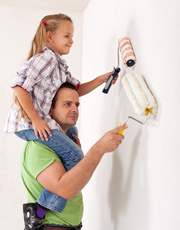
Painting a room is another DIY task that is safe and fun to do with your children, aside from the potential to make a mess, but that’s what floor covers are for.

This task will be a perfect way to teach your children about colour co-ordination as well as teamwork skills as they work together.

First, choose a room to paint (ideally a bed room or common area), then take a trip to your local hardware store to pick out the colours you all want to use, as well as grab some brushes and rollers.

Once you have your paints and brushes at the ready, cover the floors and furniture with floor covers or old sheets you don’t mind getting messy.

Next, use some tape to cover up any areas you don’t want to get paint on, like electrical sockets or skirting boards.

Finally, using your rollers and brushes, carefully paint the walls as a team, with younger children doing lower areas, older children doing middle areas and parents doing higher areas. Make sure to take breaks and have fun with your kids during the process!

After the fun is over, cleanup is just as important—especially when little hands are involved. If you’re wondering how to get paint off hands, gentle soap and warm water often do the trick for water-based paints. For tougher stains, a dab of baby oil or a mixture of baking soda and dish soap can help lift the paint without irritating the skin.

Planting a Garden

If you have a green thumb and want to pass that onto your children, planting a garden is a great DIY task to do with your children outside in your garden.

Planting a family garden is a fantastic way to teach your kids about nature and responsibility, and a great way to get them interested in biology before starting science lessons.

First, take your children out to your garden and choose a sunny spot to plant your family garden.

Once you’ve chose an area, clear the space of any weeds or garden debris and remove the grass to get to the soil.

Next, dig small holes in the soil for each plant or seed, making sure to leave space for the plants to grow.

Finally, plant the seeds or plants in their fresh holes (making sure to add extra soil to fill any space left),and water them regularly. Make sure to involve your kids in regular watering sessions to teach them about the different types of plants you’re growing and give them some responsibility.

Share This Article