Google Online Games

Google Games

Google is helping kids to be Internet Awesome! Through fun interactive Google online games, kids can learn how to be better digital citizens by learning important lessons about online safety. Access to this amazing world can happen at home or in school. These Google games take kids on a journey to “play their way” to being awesome people on the internet.

We all need to be prepared to make smart decisions while online. It doesn’t just happen. It takes education on how to safely explore the world.  Along with Google’s initiatives, there are plenty of free online educational games for kids that make learning fun and interactive while teaching valuable skills.

The Google ‘Be Internet Awesome’ Program

Google is makes learning fun while playing a free online game they developed. Simple common sense lessons are learned, such as how to focus on positive online activity, instead of negative comments and hurtful attitudes.

Deciding not to engage or contribute to the hate that divides us is a choice. The multi-level Google game teaches kids what to do instead and where to safely do it. Kids can start their exciting journey now to Be Internet Awesome.

Apart from kids playing the actual game itself, Google has provided helpful resources for adults to join in the adventure to re-enforce what is being learned online. These include downloadable guides for families and printable classroom activities for teachers. We’ve provided a link to these Google resources near the end of this article.

Learn the Internet Code of Awesome

This Google game, as well as other online games that can even teach kids coding, can equip players with life long tools they can build on. 

Playing games has also been proven to help players deal with emotions related to feelings of anxiety. 

You can have more fun by exploring Doodle for Google Games, which are part of the Doodle for Google Contest.

Here are the five educational focal points kids will learn throughout their online quest to be internet smart, alert, strong, kind and brave.

How to be Internet Smart

It starts with learning how to ‘share with care’. Toys in the offline world are shared with friends we trust. So why be careless about sharing our personal information and pictures on the internet? These can easily end up in possession of those we don’t know if we are not careful.

Be Internet Alert

Don’t ‘fall for fake’ by becoming aware that things online are not always as they appear. Information needs to be ‘fact checked’ from reliable sources. Social media is a powerful resource to connect us with others, but can just as easily be used to spread incorrect information.

Be Internet Strong

Are your secrets secure? Exactly what personal information is at risk with anyone that is interacting online? It’s an important lesson in protecting personal privacy. Knowledge in safe practices translates in the power to protect oneself. This is just as important for kids as it is for adults.

Be Internet Kind

Google games helps kids learn responsibility online while instilling a valuable belief that it’s ‘cool to be kind’. It not only benefits others and makes them feel good, positive benefits come back to make our own lives better as well. Collectively, kindness makes whole world a better place both offline and as a good digital citizen

Be Internet Brave

Talking to someone we trust can often be the most brave thing of all when facing a difficult situation online. It may be cyberbullying or a simple problem of how to react to something a child comes across online. We operate in a digital world but the most valuable conversations happen in person, whether at home or at school.

Use our Safe Game Tool to find Safe Games to Play Online

Google Internet Awesome Resources

The Google interactive game consists of four levels of learning and takes place with Interland. Kids will learn digital safety while having fun.

Educators can download the Be Internet Awesome Curriculum. This includes lesson plans and the ISTE Seal of Alignment and activities that reinforce what kids are learning through the Google game.

Parents can download the Be Internet Awesome Pledge. This will begin a conversation about online safety. Playing the game online while interacting with parents and siblings offline can open the door to discussion and questions being answered.

Get access now to these resources and learn how Google is helping kids to be safe internet explorers of the online world.

Gamification

Games do more than entertain when gamification is in play.  It’s more than game-based learning where learning is implemented more deliberately.  It can also enhance learning by teaching life skills through simulator games

Share This Article

Encouraging Your Kids Through Seasonal Affective Disorder

child outdoors in winter

Seasonal depression is tough for anyone to deal with — but it’s especially tough on kids. That’s because kids usually don’t understand concepts like seasonal affective disorder (SAD) or vitamin D intake, and the winter seems to drag on forever for them.

But the reality is that they will probably suffer from some amount of depression until winter ends.

That doesn’t mean you should lose all hope. Just like the rest of us, kids can mitigate their symptoms of seasonal depression with a good, healthy diet and a few engaging activities that keep their minds stimulated.

Here’s a short guide to encouraging your child through SAD.

Identifying Seasonal Affective Disorder

Nobody is quite certain of what causes SAD, but medical experts know that children who have a family history of SAD are more likely to suffer from the condition. Symptoms of SAD are usually quite easy to spot once you know what you’re looking for, and include:

  • Irritableness
  • Constant tiredness
  • Lack of energy
  • Difficulty functioning

Of course, we all display these “symptoms” once in a while, but you should only start to consider seeking a SAD diagnosis if they seem to persist for two weeks. This diagnosis will get you the medical help you need and will help everyone in your family understand why your child may be “acting up” in the winter months.

Eat Nutritious Foods

Combating seasonal depression can be tricky. Hopefully, after you receive a diagnosis your doctor will give your child a treatment that replaces the vitamin D that they have not received through sunlight.

But, you must also ensure that you provide your child with a nutritious, well-balanced diet. That’s because poor nutrition, particularly at breakfast time, is amongst the biggest mistakes a schoolchild can make. Children who don’t eat breakfast are more likely to feel tired during the day and will have a hard time focusing at school. This will compound the problems they are facing while dealing with SAD.

If you aren’t sure of what a “nutritious” diet looks like, then you can always get in touch with a dietitian or nutritionist who specializes in child development. They will likely recommend you include more “brain foods” like eggs and kale and should avoid sugary food and drinks that will simply deepen your child’s depressive dip.

Fortified Foods and Supplements

Aside from eating a healthy, balanced diet, you may want to check out the vitamin D levels in your foods. That’s because, according to Yale doctors, most of us do not need to get our vitamin D from sunlight. In reality, most people can get all the vitamin D they need through fortified foods and nutritional supplements.

You can usually purchase vitamin D supplements from your local pharmacy or grocery store and should check the labels of foods like milk, juices, and cereals. That’s because most production companies will fortify their goods with vitamin D, and there is nothing wrong with getting your daily intake from these sources.

Connect With Activities

SAD makes it difficult for kids to find energy for activities and can leave them feeling dissociated and disinterested in family bonding. So, as a parent, you might need to raise the stakes and provide even more attention to your kid while they are battling SAD.

There are plenty of wintertime activities for you to choose from, but it’s worth bearing in mind that your child probably doesn’t want to feel cold or exhausted from exercising in the cold while they have SAD. For this reason, activities that center around a fire pit are perfect — your child stays warm, puts down their devices, and goes outside for at least an hour or so. You can make it into a more engaging activity by having them cook food over the pit and allowing them to help you tend to the fire.

Get Professional Help

The reality is that SAD isn’t something that most parents can deal with on their own. As much as you want to help your child, you are not a medical expert and might end up doing more harm than good if you don’t seek expert advice.

Fortunately, SAD is a medically-recognized condition and is amongst the common mental health issues that children face. This means that medical professionals have seen the condition before, and are well equipped to help you handle a case of SAD. This gives you confidence that your approach is backed by research, and that you’re doing all you can to help your child through a difficult time.

Conclusion

In the depths of winter, seasonal affective disorder can feel overwhelming. But, by taking a proactive, evidence-based approach to SAD, you can help your child mitigate their symptoms. In particular, you should review their diet to see if sugary foods are compounding the issue, and should seek medical advice from doctors who are well equipped to help your kid overcome the challenges they face during the winter.

About the Author
About the AuthorKatie Brenneman is a passionate writer specializing in education, mental health, family lifestyle and online safety. When she isn’t writing, you can find her with her nose buried in a book or hiking with her dog, Charlie. You can follow her on Twitter.

Share This Article

How to Use Instagram as a Teaching and Resource Tool

How to Use Instagram as a Teaching and Resource Tool

There’s no denying that Instagram is a powerful tool. Not only for advertising and e-commerce businesses, but it can be a great resource and tool for teachers too. Harnessing the social media platform’s strengths — its rich audio-visual experience and accessibility — Instagram can be the key to engaging with both kids and their parents.

Why Instagram?

Instagram’s content is filled with inspiration. Whether you’re a teacher by profession, a tutor, a mentor or just a parent who wants to stimulate their child’s creativity, the photo and video sharing platform is a great place to begin. In fact, studies have shown that Instagram is able to improve a student’s motivation to learn and their class participation.

The fact that the app can be accessed through most mobile devices in the market today, makes it a viable option for any parent — no need to spend on expensive devices and software! The app is also extremely user-friendly, so kids and parents alike won’t need any technical know-how to be able to navigate it.

We’ve listed some effective ways you can use Instagram to encourage engaement from from students:

Use Hashtags for Inspiration

As mentioned, Instagram is filled with a ton of educational and inspirational content. You just have to know where to look. If you don’t have specific accounts in mind, all you need to do is search for trending hashtags.

Searching for hashtags is highly dependent on your needs or your niche but these are some of the most popular hashtags used by teachers today:

  • #TeachersofInstagram
  • #Teachherlife
  • #ClassroomIdeas
  • #TeachersFollowTeachers
  • #TeacherInspiration

You can also type your keyword on the Instagram search bar and the top hashtags will pop up. Click on your desired hashtag and you’ll find hundreds of thousands of posts at your disposal.

Clicking through hashtags can help you in so many ways. You can find lesson plan ideas, new activities, workshops for kids, fun classroom setups, and so much more!

Once you find posts that you like, you can click on the Save button in the bottom right corner.

Pro-tip: Make sure to click “Save to Collection” and label each category accordingly. This way, you can easily navigate through your saved posts and find exactly what you’re looking for.

On the flip side, if you have helpful content to share that other teachers can use as reference, don’t forget to use a hashtag to make it searchable. Using a hashtag on your post can also help you boost engagement. Additionally, you can use free Hootsuite alternatives to schedule your Instagram posts at once allowing you to have some extra time to focus on more important work.

Showcase Your Students’ Work

Instagram is first and foremost a content-sharing platform. As a teacher, it’s one of the best stages for showcasing your student’s work. Think of Instagram as your digital bulletin board where students can be recognized.

Having a digital bulletin board is also helpful as parents can keep track of their child’s progress and find out what they’re doing at school.

You can also use Instagram Stories to create collages of student projects or share live updates on activities and classroom events.

Post Class Updates

While printed circulars and memos may feel more official, keeping things paperless and digital is more cost-efficient and earth-friendly.

Posting assignments and class updates on Instagram is a fun way to keep the parents updated. You can also make parents part of the decision-making by using the Instagram Story Poll Stickers. For instance, they can decide on themes and field trip locations. Some schools may pair this with an online course platform that allows much of the course content to be hosted digitally.

The Instagram account can also be a way for parents to reach out to you directly and ask questions.

Capture Memories

Class picture day shouldn’t be the only day immortalized in photographs. So many fun and special moments happen every day, and parents won’t always be there to see them. Keep the memories alive with regular posts about daily activities.  Feature classroom projects, artwork or kids having fun during recess.

Use Instagram story design to document special events and fun memories with more flair than a regular post.  Remember to highlight (pin to the top) the stories of major events you want visitors to see when they visit your classroom profile.

Interact with Fellow Teachers

One of the most valuable aspects of Instagram is its wide user base. With over a billion users and rising, there must be hundreds of thousands of people just like you. If you want more resources and ideas, one of the best ways to do it is by connecting with other professionals.

If you’re a kindergarten teacher, for example, you can find someone with the same credentials  by using the search bar or hashtags. If you want to be searchable as well, you can put “Kindergarten Teacher” in your bio description.

You can learn so many things by talking to people! Imagine connecting to fellow teachers from across the world. You can exchange ideas and learn from each other, a luxury that was close to impossible before social media was created.

Create Instagram-themed Assignments and Activities

This is an activity that has to be done in collaboration with parents. For example, you can do a student Instagram takeover, where parents will help the child share snippets of their days on the class’s Instagram account.

It can be simple as sharing:

  • What their favorite breakfast foods are
  • Their hobbies
  • Their pets
  • What they like to do on weekends

You can also assign a student Instagram Photographer for the week, who can take photos and decide on captions per post. This will help inspire their creativity and perhaps develop their talent in photography.

Having an activity such as this can be a great segue into teaching your students responsible social media usage (it’s never too early!).

Things to Keep in Mind

Exposing children to social media at such a young age is a sensitive topic. It’s important to have strict guidelines when navigating the platform and make sure that parents are aware and onboard. An added bonus would be to include instruction on how students can maintain a healthy relationship with social media.

Before creating an account, you’ll also have to double-check your school’s regulations.

Public or Private?

Posting photos of minors on the internet without the consent of their parents is a big no-no. But if your account is completely private and shared only between the parents and students in class, then it is a discussion you can have with everyone.

To be safe, you’ll have to ask parents to sign a waiver that states that they allow you to post images of your child in your class’s Instagram account. With the many issues surrounding child security, it’s best to take necessary precautions for every child’s safety.

This account should be an official class account, with nothing but class-related content. Followers should only be the parents of your students and if necessary, school administrators.

Unless you get the go signal from all parents, do not post any photos of your students on social media.

Educating Your Students About Social Media

Sure, Social media can be an awesome place for learning but it can also be a dangerous place for kids. Children should know about the dos and don’ts of social media even at an early age, and even if they won’t be using the account themselves!

Rather than teaching your students that social media is a bad thing and just a distraction, show them how social media can be used wisely and mindfully. A positive experience with the internet early on might shape the way they use it in the future.

Pro-tip: For virtual learning, easily split educational videos with Clipchamp.

Instagram is going to be part of your students’ lives sooner or later, teaching them responsible usage and digital citizenship is a must.

Wrapping up

Instagram is a fantastic tool and resource for teachers. All you need is a little creativity and it can be a great way to engage with your students as well!. It’s important to experiment with what works best for you and your class.

If you’re still a little bit hesitant, just remember that social media is here to stay, so might as well embrace it!

Read about how parents and teachers alike can guide kids how to stay safe on Instagram.

Share This Article

How to Play Wordle (for kids too)

How to Play Game of Wordle

Wordle is a popular online word game. It’s limits you to only playing once per day.  You have six tries to guess the word of the day.  After hearing about it and then giving it a try, many players are quite surprised at how easy it was to do.  This means kids can play as well with great success while using their brains to think of words.

After all, the best educational games online are the ones that help you learn without making you work too hard. Wordle was not designed to stump players in the same way a difficult word game would.  It was created to give people a little fun each day, only for a few minutes.

You can’t overplay the game.  As mentioned, you can only play once a day.  Another thing that makes the game unique is that the everyone playing throughout the world is trying to figure out the same word.  It’s also an excellent way to reduce stress by playing a simple game.

Each daily word is five letters long.  You have six tries to guess it. Each guess reveals which letters are in the word. This game from The New York Times is played from any web browser and is not to be confused with the Wordle game in the app store.  It’s also called Wordle but is an older different game.

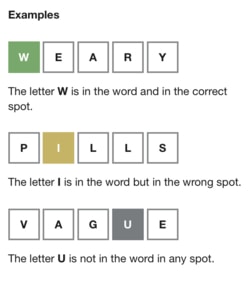
Wordle Game ExampleLetters in green mean you have that letter in correct spot.  Letters in gold means that letter is in the word, but in the incorrect spot.  Gray letters do not exist in the word at all.

Subsequently, grayed letters eliminated from the word are removed from the letter selection box below the game. This makes it simple to try different letters to attempt new words because there’s no need to need remember which letters belong.  This makes Wordle possible to solve in six tries.

Wordle in the Classroom at School?

Teachers in school are always looking for ways captivate the attention of kids in the classroom.  The rule for cell phones in school is usually for students to put them away during class. But what fun it would be if kids could could our their phones to play the game together.  Students may already be using a tablet, in which case you could play from there.

The idea is to have everyone in the classroom play the game without sharing their progress with others. Some kids will discover the word earlier than others.  The teacher can be available to assist individual students throughout the class as they play.  Students who complete the game can show their teacher they solved the word and put down their phone or tablet until everyone is done the game.

There are many ways to become better at playing word games. This results in kids wanting to play them more.  In turn, they become more educated about words.

How to Play Wordle

Now that you know how letters in the daily word game are revealed and excluded, you are ready to play.  How you start the game is really quite simple.  First, let’s run through the steps of how to win the game.  The link to play is at the bottom of these instructions of how to play Wordle.

Once you have the game pulled up on your screen, you simply need to take a guess.  Enter any five letter word you can think of. Press enter and you will immediately be shown the possible letters in the word, as showed in the image above.  In this example to the left, the word we in a past game showed that none of letters entered were in the word. Those letters are grayed out below so you know to ignore them.

How to Play Wordle

The Word Game Called Wordle

If a word does not exist your guess isn’t wasted.  The game will tell you that the word is not in the Wordle list and you can try again.  As you guess the word in your second try, you now which letters to exclude from your guess.

Here is how this past game was won in four tries.

Play Wordle

The second guess eliminated additional letters and revealed one letter that was in the word, but not in the correct place.

The third guess showed one word that was in the correct spot and two words that were correct but in the wrong place.

After the process of elimination, the word was guessed.  Remember, if you enter a word that does not exist it will let you know. You won’t waste a turn trying.

Play Wordle Every Day

So whether you play alone, friends, your family, or your classmates – the game of Wordle is not has difficult as it seems.  The game is even attracting people new to crossword puzzles and word games. Players that normally don’t enjoy Sudoku’s and Scrabble’s gameplay, are enjoying Wordle.  They like it because it only allows you to play once a day. You don’t need to download an app, just use your favorite browser.

It’s a good idea to use the same browser everyday because your browser cookies will show your progress after each game every day.

Now you’re ready to play!  Share this page and spread the joy of Wordle.  Play your first game at https://www.nytimes.com/games/wordle/index.html.

Share This Article