Category: Education

5 Things Your Child Can Learn Online

Things your child can learn online

When it comes to showing your child the internet, there’s a lot to explore. It can be overwhelming knowing where to start. Just because there are dangers online shouldn’t stop parents from exploring productive and beneficial opportunities for kids to learn. It’s all about finding the right programs to benefit and complement their real-life learning skills.

If you’re not too sure where to begin when it comes to the internet and your child, let’s talk about five things that your child can learn online.

1.     Try a Readability App

A lot of kids struggle to learn to read. Whether it’s at home or kindergarten, for some reason, they’re just not getting it and coming to you frustrated. Teaching them to learn how to read is also easier said than done.

However, there are now online resources that make it a little easier to teach your child how to read. A readability app has a variety of different reading programs to encourage them to persist and learn an important new skill. From pointing out where they make mistakes to encouraging different reading levels, this is a great way to build up your child’s confidence around reading.

2.     Teach Them Math

Math is another tough skill to teach a child, especially if they’re not naturally inclined that way. Luckily, there are a number of different online resources that can not only prepare your toddler for what they will learn in school but can also make learning math fun and interactive.

Whether it’s a math learning game or math training that improves their skill levels, you’ve got many different options to choose from.

3.     Ignite Their Creativity

You may not know it, but there are a lot of resources on the internet for kids that aren’t just mindless games. In fact, there are game apps made for kids with education in mind, designed specifically for the purpose of encouraging their creativity.

Make sure that you find a game and encourage the child to think for themselves and inspires them to use their imagination and get creative.

4.     Learn to be Organized

One of the biggest skills that your child will learn as they prepare to start school is how to be organized and plan ahead. When they’ve got to get up and make their lunch, get dressed, and remember what homework they have to hand in today, having planning skills is going to make all this a lot easier.

There are now quite a few apps that can help your child plan ahead, so they can see their schedule in front of them and not get so overwhelmed by the day.

5.     Improve Language and Grammar Skills

Another essential skill for your child to learn as they get ready to start school is grammar – and, of course, language. These two go hand in hand with reading, so it’s no surprise that there are interactive apps and games that can help improve your child’s grammar and language skills.

While the internet can be tough terrain from time to time, there’s also a lot on offer when it comes to your child learning new skills. Make sure to keep them safe online too, and monitor their activity whenever you can.  There are also methods to help limit your kids screen time to ensure a proper balance between all of their activities.

Around the World Online With Kids

Share This Article

Around the World Online With Kids

The world is a big and exciting place, filled with adventure and ideas. The world is also more and more online. Even though you explore Earth with your fingertips, the reality of kids in other lands and their online experiences may surprise you.

CHINA

The largest country on Earth has the most people online. 800 million people in China use the Internet, but that makes sense because it has the most people living there. The Chinese also see a different online world than other people, because the government controls Internet searches and there are some websites that the Chinese government keeps from coming up when people do a Google search. This is a problem that companies still fight about.

Kids in China mostly use QQ or WeChat to connect with their friends. Unlike kids in the US, Canada or most countries in Europe, kids tend to use the internet for school or to chat with small groups of friends. Kids in China also know that too much Internet can hurt their school marks and keep them from being who they want to be when they grow up.

NIGERIA

People in this West African country are quickly becoming huge Internet users. The biggest problem is that electricity isn’t always available. The power can go out a dozen times a day. Children lucky enough to have Internet service tend to concentrate on education, because for many, becoming educated will help them escape poverty. Unfortunately, many who are educated grow up to use the Internet for crime. Pretty much everyone online has come across a Nigerian scam. Hopefully, as more children get a good education, fewer will turn to scamming.

INDIA

If you are between the ages of 8 and 13 and live in India, you are probably using Snapchat to connect with your friends. Parents of those kids don’t like Snapchat because they can’t see what their children are sharing. Most parents think that they know what their kids do online, but about half of those kids disagree—those are kids who spend time online with activities their parents don’t know about.

To help protect kids, India has passed laws that make going online illegal for children under the age of 18. That has not stopped kids from signing up for Facebook and Google accounts. India is working hard as a country to better watch their children as they enter the online world.

JAPAN

Japan has kids that spend so much time online, they are suffering from physical and mental problems. Many can’t sleep or concentrate, have problems eating and are becoming physically unfit, to name only a few of the symptoms. Doctor’s call this either Internet Use Disorder or Problematic Internet Use. Boys are more likely to have problems due to playing games online. Girls are more likely to have problems with messaging and social platforms.

Parents, doctors and school officials are looking for ways to help bring children back to the real world. Many Japanese parents are turning to camps where kids are put on an Internet “fast.” Instead of going online, children go outside and play, talk with each other and even go into counseling.

YOU

You are very lucky. You are reading this, so, obviously, you have a computer or a smart phone. You also have an internet connection. You can learn about our planet and can read different points of view. That isn’t the case for all kids in the world.

Remember, life is much bigger than your social platform and friends. We can all learn from each other to better explore the Internet while living fun, happy lives in the real world.

The Best Place in the World to Live

The world is filled with many strange and interesting things.  One of those things is the weather.  People are always grumbling about it. Many think that life would be so much better to live if only they moved to a better place. The fact is, every place is both the best place to live and the worst place to be, depending on the time of year. Let’s take a little trip. Grab your globe or a map of the world and buckle up.

Many people in northern climates dream of living on the equator. After all, they say, life would be so much better without cold and snow. Rainy season in Mexico can last from May to November. That’s seven months where outdoor activity is sloppy and wet. When the rain stops, the world blooms in green and flowers that would shame a rainbow. The lush growth makes places like this a wonderful place to live—after rain season, that is.

All up and down the southern Atlantic coast (check your map) is where you find hurricanes. They are the wicked monsters of weather, blowing cars and homes and even chunks of bridges up in the air. Millions of people have to live with damage caused by hurricanes each year. Most of the damage is in places known for hot, pleasant weather, like Florida, Puerto Rico, Haiti, Central America and the east coast of Africa.

Maybe you’ve longed to live in someplace known for easy, comfortable climate, like, say, California or Switzerland. Okay. But be warned that these are places known for mudslides. Mudslides occur when large amounts of water flow down steep slopes. The mud can be so thick, it can wash away whole towns.

Mudslides and landslides happen all over the world, from Nepal to Peru to Southeast Asia and back to Venezuela. There are gorgeous mountains and lush vegetation—but a good rain can send a mountain sliding down.

Some of the most sunniest places in North America are in winter climates. The temperature is cold and well below freezing, but seeing the bright sun every day can be uplifting. People who live along the Pacific coast enjoy warmer winters, but during the winter the it’s mostly cloudy. In certain areas it can rain continuously for 3 or 4 months straight. In those cases, the sky can be very dark on a daily basis.

Many hot countries are too hot to go out and play during the middle of the day. Lovely island countries like Japan can face tsunamis, which are huge, powerful waves. The wide prairies have to deal with tornadoes. No matter where you live in the world, the weather can be wonderful or it can unpleasant.

The planet is a dynamic place with changing seasons and weather conditions. Luckily, human beings are smart. We are adaptable. We can live happily almost anywhere. The trick is to understand that no place is perfect and every place has its magic and beauty.

True, there may be reasons why your parents decide to move your family because of a job or finding a neighborhood with a good school for you. But wherever you are, when bad weather comes, you have the power to get through it. You don’t have to move to enjoy the world. Just listen to your parents and put on that scarf!

5 Little Things That Make the World Better

Every morning you wake up to a new day. You have a fresh day to have fun, get into trouble, be lazy, eat something tasty—and make the world better. Here are 5 LITTLE THINGS that take only seconds, and you can do them! When you do one every day, you make the world a better place.

1. Pick up a piece of garbage.

That’s all. You see a gum wrapper in a parking lot—pick it up and put it in the trash bin. It may seem small, but this one little act makes your world a little better every time you do it! And if you pick up a piece of garbage every day of your life, imagine the pile. That is the difference you can make.

2. Give someone a compliment.

“Hey, good job on that paint job.” “I like how you got that program to work.” “Cool moves!” No matter who you hang with, no matter what you are doing, you will have a chance to say something positive to someone in your life. That kind act can make a huge difference to the person you compliment. That person will feel better and think better about the world—and you. And it’s so easy. Practice on your parents.

3. Learn one thing every day.

We’re not talking about the learning you do at school or that stuff your parents keep reminding you about. You have eyes and ears and a brain that takes in the world. Ask yourself one thing about what you see or hear and find the answer.  There is a lot you can learn online, just Google it!

You only need to do this once a day to get into the habit of thinking. You could be riding your bike and think: When did humans first discover the wheel? You could see a weird looking bird and wonder what kind of bird it is. Why do you have those two sharper teeth on the sides of your mouth?

Learn about interesting days in history.   By asking questions and looking for answers, you will make the world a better place, because the world needs more people who think and look for knowledge.

4. Say thank you.

Like giving people compliments, when you thank someone, you are connecting with that person. The more people connect—even when it’s just thanking a clerk who hands you a napkin—the world become a little better.

5. Smile! 🙂

Share This Article

The Flipped Classroom | Using Video and AI To Improve Student Experience

Think back to the popularity of Smart Board use in the classroom. Technology provides a way to show students a wider range of opportunities. Today, 86% of educators – including teachers, principals, and more – believe students need to enhance their tech knowledge, and learn video capturing skills to succeed in order to succeed in their future workplace.

Why so? Using video maximizes classroom time. Education institutions have reported some interesting numbers, documenting that 91% of students experience satisfaction when learning by video. Not only is the student more satisfied, but their achievements improve by 82%, as well.

Benefits of The Flipped Classroom

A flipped classroom flips the traditional approach to learning and it results in reapable benefits.  With flipped focus, students learn new content outside of class, through video and tech. A flipped classroom proves beneficial because the focus is 80% student-centered, and students discuss and explore applications in-class.

On the other hand, traditional teaching only centers 35% of instruction on the student. Teachers review homework and present new content in class, while students are left to do homework and practice what they’ve learned after school hours have concluded.

The benefits of a flipped classroom are endless. Primarily, a flipped classroom increases student engagement, allows learning to be more collaborative, and guides students to self-discovery.

Of course, there are challenges in any instance. Pointing this out, a flipped classroom can easily become active, noisy, and distracting for those who struggle to work in the aforementioned conditions.

Furthermore, flipped instruction must be strategically executed for reapable benefits to be available as students may have trouble focusing in a flipped learning environment.

Use of Artificial Intelligence

In order to improve the educational experience on behalf of the student, more artificial intelligence will be implemented into the classroom. The same goes for embracing new technologies for learning, such as virtual reality.  Educators are also using chatbots to provide self-paced learning for the student, track performance, provide immediate feedback, score assignments and tests, and communicate with parents.

By leveraging a chatbot, educators can create personalized and interactive learning experiences that cater to the individual needs of each student, fostering a more efficient and effective educational journey. Furthermore, the use of chatbots in education can free up valuable time for teachers, allowing them to focus on more personalized instruction and mentorship.

AI tools are also being used to provide voice overs for explainer videos. With their advanced speech synthesis capabilities, these AI-powered tools enable the creation of high-quality and natural-sounding voices that seamlessly integrate with visual content. This breakthrough technology not only saves time and resources but also provides a versatile range of voice options. AI models can accurately mimic human speech patterns, intonations, and emotions, allowing creators to tailor the narration to their specific needs. ions, and emotions. 

Evolving Education

The future of education is becoming as technologized as every other industry. From 2014 to 2019, educators increased their use of video for capturing campus events, flipped instruction, providing assignment feedback, and many more tasks. Even so, 98% of educators believe video will play an important role in the personalization of education, and 89% are interested in VR/AR/360 video.

Today, 9 in 10 educators are interested in the benefits of tech to improve the learning experience for students, both inside and outside of the classoom. To learn more about how education will look for future generations, check out the accompanying graphic.  It explores the use of AI and Video, as well as the benefits and drawbacks of the flipped classroom.

Re-Imagining Schools

Additional Reading: How does virtual reality help in education?

Share This Article

Gen Z Students Reshaping College & Job Economy

College Education for All Races - Gen Z

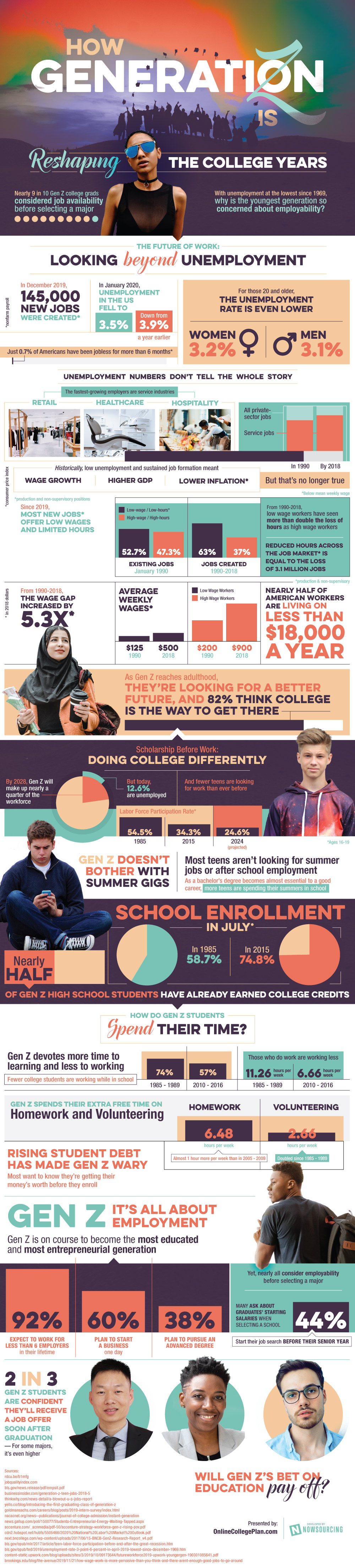
It’s an interesting time to be a student in America. The action behind asking our children, “What do you want to be when you grow up?” may have more influence than we know. Turns out, Gen Z – those born from 1995 to 2012 – is obsessed with learning. In fact, it’s common for Gen Z students to spend their extra free time on homework and volunteering.

Today, the typical Gen Z student dedicates 6.48 hours per work to homework and 2.66 hours per work to volunteering. Due to a plethora of similar habits, Gen Z is on course to become the most educated and most entrepreneurial generation.

Job Availability

Yet, nearly 9 in 10 Gen Z college grads considered job availability before selecting a major. With unemployment at its lowest since 1969 – three generations before Gen Z’s time – why is our youngest generation alive so curious about their future employability?

To put it lightly, they’re ahead of the game.

Rising student debt has made Gen Z wary, and most want to know they’ll be getting their money’s worth before researching academic programs. Schools are getting involved, as well, encouraging students to take Advanced Planet (AP), dual credit, and the International Baccalaureate (IB) Diploma Program courses and exams. Today, nearly half of Gen Z high school students have already earned college credits.

Don’t fret- students are curious, not worried. 2 in 3 Gen Z students are confident they’ll receive a job offer soon after graduation. For some majors, it’s even higher. Even more, 60% of our youngest generation on the planet impressively plans to start a business one day, and 92% expect to work for less than six employees in their lifetime – Gen Z doesn’t even bother with summer gigs.

Working for Scholarships

Most teens prioritize studying to earn future scholarships over working a job. This is the main way Gen Z is reshaping how we “do” college as a society. Nearly half of American workers are living on less than $18,000 a year, and Gen Z is privy to this, so 82% think college is the way to get there. In the meantime to graduating high school, most are most focused on earning grants and receiving financial aid to afford college.

Interestingly enough, one in three 15-year-olds plan to pursue one of the top 10 most popular occupations, regardless of whether or not their desired career will still be in-demand by the time they’ll be eligible for hire. Gen Z is ahead of its time – it’s all about employment for them. As we witness our very own children reshape the college years, continue to ask them, “What do you want to be when you grow up?”

Infographic:  Reshaping College Years

How Gen Z is Reshaping the College Years

Read how Industry 4.0 will impact students.

Share This Article