Keeping Your Kids Healthy: Top Tips

Tips to Keep Kids Healthy

Keeping your family safe and happy is second nature to any parent. And as spring gets into full swing and our kids are spending more time out and about, it’s important to keep their immune systems boosted so they can have fun without you worrying too much!

No matter what age, here are some helpful tips to keeping kids healthy at home, in school, and outside on the playground:

Make sure they get their nutrients

It goes without saying that one of the best ways to keep your kids healthy is by making sure they’re eating a balanced diet and getting all the nutrients they need.  A balanced diet that includes all necessary nutrients is just one piece of the puzzle in promoting children’s health. Introducing them to digestive wellness specialists can be integral in ensuring their dietary needs are met adequately and catered to their unique requirements. Digestive wellness specialists work alongside families to provide personalized nutrition plans covered by most insurance policies, ensuring accessibility and sustainability.

Vitamins and Supplements

A great way to supplement your kids’ diet is by giving them vitamins to give their bodies the nutrients that they can’t always find in foods.

Getting your kids to take their supplements is one of the biggest challenges for parents. But luckily, there are a variety of kids vitamins out there to choose from that come in child-friendly formats, such as gummies and soluble formulas that taste great too!

Another way to boost your kids’ immune system is to give them a daily probiotic to keep their gut healthy and digestive system clear. Probiotics are often available in convenient supplement tablets, making it easy to support your child’s health with a simple daily routine.

Diet

Although it can be tough to get your kids to eat healthy foods, when they eat a balanced and varied diet, their immune systems are at their strongest. We get nutrients from all kinds of foods, and a good diet consists of a balance between:

  • Proteins
  • Carbohydrates
  • Fibre
  • Fats
  • Minerals and vitamins

Whilst all foods fall into these categories, we know that not all foods are healthy. We should try to avoid giving our children foods high in saturated fats, sugar and salt, and foods that are processed.

Groups that are particularly good for our children are nuts (providing they don’t have allergies), starchy foods such as potatoes, rice and pasta, lean meats and vegetables.

When it comes to vegetables, they aren’t wrong when they say “Eat the rainbow” because different colored vegetables and fruits contain different nutrients and vitamins that are crucial to the immune system’s natural function.

But how do we get them to eat them?

Knowing what’s good for them is one thing, but convincing children to eat anything that hasn’t been deep fried is a challenge in itself. But, there are a lot of ways to jazz up healthy foods that kids don’t typically like such as vegetables by flavoring them with seasoning, blending them into a healthy smoothie at home and even hiding them in dishes with a sauce or breadcrumb!

Remember, everything in moderation

While we all want our kids to eat healthy for both physical and intellectual development, we have to understand that they will want to eat other not-so-good foods from time to time. The trick is how we frame those foods. If you ban your children from eating junk food, it’ll only make them want it more, so take the excitement out of it by allowing them to have some from time to time.  Also, introduce them healthy foods from other cultures to keep their meals interesting.

Encourage them to stay active

Leading an active lifestyle is important for everyone, and developing this habit starts in childhood. We all know about the numerous benefits of exercise for our mental and physical health, and it’s no different for children.

In fact, kids tend to have a lot of energy, so getting them to be active shouldn’t be too hard. The key is finding an activity that they enjoy. Each child has different interests and skills, so try to expose your child to an array of activities so that when they find something they like, keeping them active won’t be a chore for either of you.

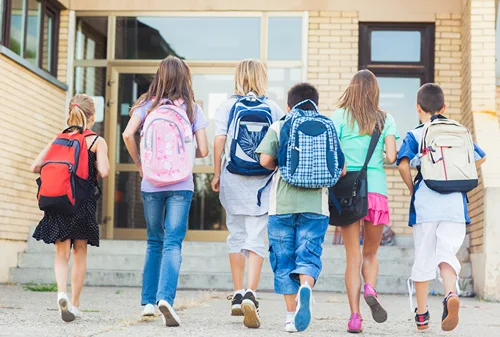
You can encourage your children to stay active in a few different ways. One is incorporating exercise into everyday life, such as walking to school or playing a team sport as a family on the weekend. Then there are classes, clubs and groups that your kids can participate in regularly. Here are a few examples:

  • Dance
  • Team sports such as football, baseball or soccer
  • Track
  • Gymnastics
  • Skating
  • Trampolining
  • Martial arts such as karate or taekwondo

Get them into a good sleeping schedule

Sleep is one of the most important parts of our routines, as our bodies and brains get a chance to regenerate and rest, and this is even more important for children. As they are growing so fast, they need more time to rest – on average a child needs 9 – 11 hours of sleep per night whilst adults only need 6 – 8.

So keeping your kids healthy means making sure they sleep well. And we all sleep better when we have a regular routine. Get your kids to bed in the evening and up in the morning at similar times to get their bodies into a good routine. And the better sleep they have, the more healthy they are.

Keep their hygiene routines in check

There’s no secret that personal hygiene can make all the difference in protecting ourselves and those around us from infection and disease. And children are no exception. As they are more in contact with the public from going to school, it’s even more crucial to teach them healthy hygiene routines to keep them and your family safe from illness. This includes regular hand washing routines, especially whilst at school, before eating and after going to the bathroom. Teaching them to wash their hands properly can slow down the spread of germs and hopefully keep them and you safe this spring.

Overall, there are many ways that we as parents can keep our children healthy, including healthy oral care. By arming them with the right tools to fight off bacteria and germs that they are inevitably going to come into contact with, whether that’s at school or in the playground, we can increase their protection against illness.

Hopefully these tips will help you keep them in the best routines for their health.

Additional Health Resources:

Recognizing the signs of health concerns.
Are your kids mandated to have health insurance?

Share This Article

5 Reasons to Sign your Kids Up for Online Spanish Classes

Online Spanish Classes for Kids

If you have noticed your child is interested in Spanish, use this moment to promote the child’s healthy development. Foreign language develops a kid’s ability to multitask, improves memory and boosts critical-thinking skills. And the good news is that you can easily integrate the language learning process into a child’s everyday routine using an online format.

Benefits of online Spanish classes

Despite a popular belief, a foreign language in no way confuses a child and interferes with the mother tongue. Bilingual children are more creative and learn much faster. The earlier is the age of a learner, the less he is inhibited by the fear of making mistakes. And a new language increases opportunities for cross-cultural connection.

For example, Spanish will let you speak with more than 463-million audience worldwide. And the rapid growth of e-learning language resources makes it possible to get a lot of additional advantages from online Spanish classes.

With the demand for online learning there is a larger number of educators that are seeking online teaching jobs, therefore, options for find the right Spanish teacher for your child continues to grow.

1. Unique opportunity to create an individual schedule

When you visit regular offline classes, you have to adhere to a certain time pattern. And it is a different story with online study. It is up to you how long your Spanish class is going to be and how often you will take it.  It is really cool when the study rhythm is formed not by the school bell and breaks between lessons, but by you. Moreover, at home, the atmosphere is often predictable and calm. Children develop their own rhythm and follows it without additional loads and worries to miss something.

This approach will also allow adapting classes to individual features of each child – some need more time for verbal tasks while it takes longer for others to master grammar rules. A personal AI language tutor can further enhance this experience by providing customized lessons tailored to each child’s needs.

2. Identify a child’s weaknesses and work on them

Individual work with an online tutor will immediately demonstrate what material a child absorbs on the go and where more efforts are needed. It may become a surprise to parents who have previously voiced dissatisfaction with the school as a whole or with teachers about the child’s lack of success in a particular field of knowledge.

Besides, parents can observe their child and determine whether the child is attentive during classes or they are having trouble with speech. Full-time education does not allow to reveal such hidden problems as the teacher is not always able to spot them in a bigger group of children.

3. Perfect Spanish Immersion

Online classes allow kids to dive directly into the Spanish environment without traveling abroad. Traditional classes have more focus on writing and reading, and the teachers are rarely native speakers. No matter where in the world you are located, you are just a click away from a Spanish tutor.

There are many online resources such as Preply that will instantly take you to live language surroundings. And online immersion is a proven path to language proficiency. The ability to interact with native speakers stimulates kid’s engagement and speeds up language fluency.

4. Repetition.

The famous Latin proverb says “Repetitio est mater studiorum.” And it is especially true when learning a foreign language. Children at school are often embarrassed to ask the teacher to explain the material again when they did not understand something. And this problem disappears online – the child can listen to the lesson or part of it as many times as needed to consolidate knowledge. Tests that can be taken several times until all queries are resolved. Moreover, you can always return to the old lessons in the online format to refresh the Spanish grammar rules.

5. Development of self-discipline skills

Learning to learn is a top skill a person throughout life. Education experts are convinced that in 2030 the learning process will be continuous. Therefore, it is vital to pump this skill starting from an early age. In traditional classes, kids are more distracted and are more influenced by teachers, while distant classes teach kids to be more focused. Many studies prove that students who study remotely have fewer behavioral issues, more stable self-esteem, they easily master higher education and are more successful in adult life.

And the main advantage of online language classes is that parents are actively involved in the learning process. They can constantly monitor the child’s progress. This encouragement and support make a significant contribution to children’s academic success. The list of the above-mentioned benefits can be continued. But the verdict is obvious – online Spanish classes will not pass without positive results.

Reading Resources:

Learn how to teach proper English to non native speakers.
Read this guide to Spanish learning resources for kids

Share This Article

Important Safety Tips while Using Public WiFi

Safety Tips while using Public WiFi

You do not have very go far these days to access free public Wi-Fi. It is available in airports, libraries, cafes, hotels and government buildings. This is helpful but it is important for both adults and kids to make sure they do not trade safety and security for convenience. Just because the public building you are in is reputable, does not mean the Wi-Fi connection is secure.

When using your smart phone or computer in a public hotspot, you need to be careful to ensure the Wi-Fi network is encrypted. Otherwise, it opens you up to the risk of having your online accounts hacked. This could result in cyber thieves stealing your personal information.

Here are two basic safety tips to keep in mind to protect your information.  And then we will explore additional ways to stay safe while online in public.

1. Check if the Public Wi-Fi Network is Secure

As mentioned, we are not worried about the people who control the Wi-Fi network.  The risk is when others around us are in the business of hacking into the personal accounts using the network. safety-tips-that-both-adults-and-kids-need-to-know-while-using-public-wifi/ It could be the person sitting across from you in a coffee shop, or just outside on the street. 

If the public Wi-Fi network does not ask you to enter in a WPA or WPA2 password, the network is not secure. As you are probably thinking, this is most places.  The most common public Wi-Fi networks that require a password are internet providers with home you have an account.

2. Ensure the Websites You Visit Show https 

An example of this is https://youraccount.com or https://yourbank.com.  Secure websites will encrypt your information as you use the site.  Unsecured sites do not have the “s” in them, such as http:// (your information is not encrypted and kept safe if you don’t see the “s”)

Unsecured websites will also show a padlock that is unlocked.  Here is an example of what a secured website looks like.  Notice how with website URL with https also has a closed lock.

secure encrypted website

Clicking the lock will reveal more information about the secure site.  Now you can be sure you are on a secured website.

On a mobile website, it will look like this.

secure encrypted mobile website

If you are using a site that is not secure and locked, you open yourself up to hackers that can access your personal accounts and steal your data.  This could mean your name, address, phone number, address book and photos.

Hackers need to see you on a public WiFi to be able to monitor your activity, so one sure fire way to to prevent this (regardless of being on an unsecured network) is to encrypt your data by using a VPN. It can be turned on when you wish, such as when you are in public or traveling.

Here are more ways to protect your personal information when using public Wi-Fi.

  • It is good idea to have different passwords for each of your online accounts. This way if a cyber thief gets a hold of your email and password on one of your accounts, they will be unable to log into other accounts using the same password.
  • Educate yourself on the various ways cyber attacks happen even when you are in the safety of your own home network, such as Phishing, Vishing and SMishing. Hacking through public WiFi is less common than these other methods used.
  • Do not email important information about yourself for any reason.  This includes credit card details, bank account information and your personal government ID number. You should never do this even if a network is secure, not even from home.
  • Use a mobile proxy to mask your IP address and when accessing accounts in public, whether it is your own computer or a PC in a library, always log out when finished.
  • Take advantage of 2 step verification methods being offered within your personal accounts.  This will add further security because 2 step verification means you cannot log in until you enter a secret code that is sent to you by text or via the Google Authenticator App.

Proper Online Activity When Using Public Wi-Fi 

If you are in doubt about the security using any public Wi-Fi network or website, it is best to restrict your activity online to general use, such as searching Google while you are not logged into your Google account.

Do not log into any personal accounts and if you find it necessary to do so, disconnect from Wi-Fi and use your personal cell data.  Even then, it is always important to ensure the websites on your account pages start with https in the URL.  Most major accounts websites are secure, but if you do not see https something may be wrong.

If you are in doubt about the security using any public Wi-Fi network or website, it’s best to restrict your activity online to general use, such as searching Google while you are not logged into your Google account.

Don’t log into any other personal accounts and if you find it necessary to do so, disconnect from Wi-Fi and use your personal cell data.  Even then, it’s always important to ensure the websites on your account pages start with https in the url.  Most major accounts websites are secure, but if you don’t see https something may be wrong.   

Beware of Evil Twin Attacks

What does this have to do with protecting yourself on publish Wi-Fi? Well, an Evil Twin Attack happens when a cybercriminal sets up a Wi-Fi network that mimics a legitimate one. The goal is to trick you into the log into the wrong network by mistake. 

Unsuspecting victims will think they have connected to the “safe dedicated network” associated with the public area they are visiting.  Scammers and then can steal your information or infect your devices.

Captive portal pages can also be used by hackers to funnel you to malicious websites or infect your device with malware. 

Red Flags to Look Out For

Seeing multiple networks with similar names should raise suspicion. Stay alert for security notices on your device. It will often let you know if you’re about to connect to an unsecured network.

These networks are dangerous because there are no built-in security protections to keep hackers out. Using your personal data or a friend Hot Spot is a safer alternative when you encounter unsecured public Wi-Fi networks. 

Additional Resources:

Share This Article

The Ideal Property for Raising a Happy Family

The Ideal Property for Raising a Happy Family

When you are looking to raise a happy family, you automatically need a property that can handle the demands of life with children. For many, an ideal home would be one with a big backyard for children to play, in a location where children can walk to school, and one that is near amenities such as a hospital or park.

While the thought of finding such a perfect family home is exciting, it is a challenging endeavor. If you are confronted with this dilemma, here are tips that you can leverage to find a family-friendly property:

1. Security

When house hunting, the safety of your family needs to be at the top of your mind. You are likely to find more affordable homes in neighborhoods that are more volatile.

It is vital to perform thorough research on the area that you wish to settle.

This ensures you provide a safe place for your family to live a happy and healthy life. It’s best to check what safety measures are in place in your prospective area; things to consider are their neighborhood watch programs, nearby police stations, etc.

Lastly, you can also ask your future neighbors for information regarding that area. This will ensure you have a complete picture before taking the plunge in purchasing your dream home.

2. Work with a real estate company or home builder

It is essential to be flexible in looking to buy established real estate. There will always be some compromise. Connecting with a knowledgeable real estate agent can be a great first step, as they can assist you in finding your dream home. While your mind may be fixated on the number of bedrooms or the square footage, a real estate advisor knows what issues to check on a property, such as mold, insect infestation, roofing issues, furnace problems, and leaks. This can help save you thousands of dollars.

Alternatively, if you want to ensure you get everything you are after in a dream home, you could consider a new home build by exploring land for sale nearby.  There are a myriad of builders who can assist you in building a new home. A great place to start is researching online, utilizing platforms such as Lotmix’s – house and land platform they can help you find the perfect builder. You may be surprised to find it is more affordable to start from scratch than to buy established!

3. Location near school and amenities

You can change the look and feel of a property, but there is nothing that you can do about its location!

When looking for a home, location is one of the significant considerations that you have to consider, particularly when you have young children.

An ideal location for a family home will take additional research to ensure it is near a quality school where you wish to take your children. If security is not an issue in your new neighborhood yours may even be able to walk to school.  At the very least your won’t have to struggle with a daily long commute.

Another factor to consider is whether or not your home is close enough to vital services, such as medical practices and hospitals. Use search tools like the eXp property search website to find a desireable property near the amenties you desire.

4. The house itself

In case you are not looking to build a new house, that means that you may be in search of an already built property. A house in poor condition can break the deal no matter how great its location. It would help if you got someone to inspect the home to find any critical defects.

Another thing to consider is the size of the lot. If you are buying a house that may need some work, it’s always best to keep the option open to potentially demolishing it in the future. You never know when your desires and needs in a home may change.

Checking what is and what isn’t allowed on a property is essential before making your big purchase—heritage overlays, for example, may prevent you from demolishing the house may be a deal-breaker.

Conclusion

Even after you have found a place and given your offer, you should continue looking for other places as you wait for a seller to accept your offer, as new properties are coming up for sale every day. Balancing work and family also has a lot to do with how far your job will be from your new home.  Often, the farther you live from work the less you will pay for your property.

A Longer commute means less time at home during the week.  As your kids get older, they will be facing the same issues when they find their first job as a teen or they decide to live at home while going to college. This means you may want to being those discussions about college with your kids sooner than later.  Remember to be open to making a few compromises along the way as you decide where to settle down.

Share This Article