How Much Screen Time Is Too Much For a Distance Learner?

How much is too much screen time

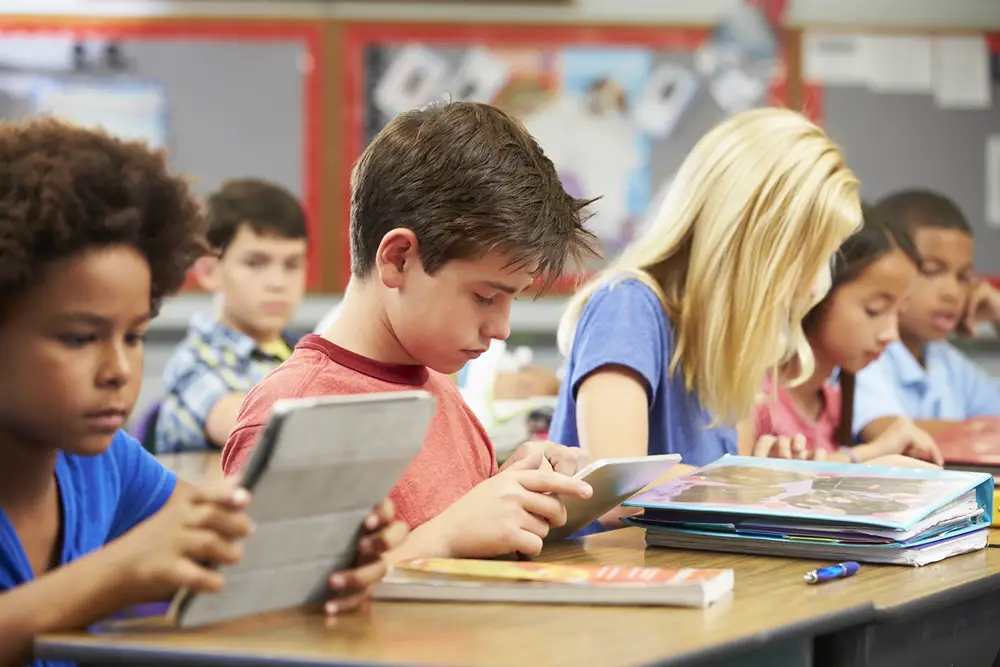
There has been a major shift in the world towards distance learning. The discussion of how much time kids can safely spend looking at screens has only become more vital.  Whether it be on smartphone, tablet or laptop, parents have usually been concerned with the time kids spend playing games, interacting on social media, or watching TV shows and movies.

Even in a normal world you would also need to add the screen time spent on school computers used for a variety of purposes. These activities include searching Google and doing research. All of these online activities add up to a staggering number of hours per day looking at screens. And now we must also take into account the time spent doing online school.

85% of parents worry about the amount of time their kids are spending online these days.

Recommended Screen Times

The WHO & CDC both recommend no more than 2 hours of screen time for children under 18.  Finding further specifics, The American Academy for Pediatrics urges a 1-hour screen time maximum for children under 6 years old. 

Furthermore, it has been found that children under 2, who regularly watch at least 1 hour of television on a daily basis, may face an increased risk of cognitive, language, and motor delays.

Blue Light Affects

An interesting consideration about screens, in particular, is their emission of what’s referred to as “blue light”. Blue light is particularly influential because it blocks a hormone that your body makes called melatonin. When you are exposed to blue light waves, especially in the evening, melatonin is not produced, so your body isn’t getting that vital message about slowing down and getting ready for sleep. If your child continues surfing the ‘net on a tablet or smartphone after getting into bed, they could be telling their body to rise and shine, rather than slow down and rest.

Luckily, if you’re concerned about the impact additional screen time may be having on your child, there are steps in preparation for bedtime you can take to help limit your child’s blue light exposure.

Home Learning Challenges

With home learning comes more indoor time. However, this makes it especially easy to develop a screen addiction. Did you know excessive screen time can be toxic to our mental health? 56% of teens feel anxious or lonely without their phone.

Yet, distance learning sessions last more than our government recommends we spend on screens altogether – even with compelling data proving its potential to be mentally and physically dangerous.  The problem is only exasperated when you consider that students use screens to access other content as well, such as entertainment and social media.

Ask Yourself How Your Kids are Doing:

  • How often are your kids exercising, whether indoors or out?
  • How social have they been since distance learning began?

The value of education should never be downplayed, but please double check to ensure distance learning isn’t taking a toll on your little ones.

In the meantime, check out the infographic below. It may help you shape a better understanding of how much screen time is too much for your children. 

Screen Time Infographic

This infographic explores the good, the bad, and necessary use on screens due to online learning.  It explores the risk associated with screen time use in spite of the need for them for the distant learner.

It also offers tips on how to get the best out of the necessary hours needed to be in front of a screen so that the time online can be reduced.

Finally, the infographic shows ways to protect kids against harmful content while on the internet.

Infographic Screen Time and Its Effects On the Distance Learner

Tips for Managing Screen Time in a Balance Manner

Set clear boundaries: Establish designated screen-free times during the day to rest your eyes and mind.

Follow the 20-20-20 rule: Every 20 minutes, look away from the screen at something 20 feet away for at least 20 seconds to reduce eye strain.

Break up study sessions: Divide study sessions into manageable chunks with breaks in between to prevent mental fatigue.

Utilize offline resources: Balance screen time by using physical books, printed materials, or offline activities for learning whenever possible.

Prioritize quality over quantity: Focus on productive screen time activities such as attending live classes, participating in discussions, and completing assignments rather than aimless browsing.

Engage in physical activities: Incorporate regular exercise or outdoor activities into your schedule to counterbalance sedentary screen time.

Monitor and adjust: Pay attention to how much time you spend on screens daily and make adjustments as needed to maintain a healthy balance between screen time and other activities.

Additional Reading:

Share This Article

9 Proven Ways To Enhance Your Email Privacy!

9 Proven Ways To Enhance Your Email Privacy

Even though WhatsApp, Facebook Messenger, Instagram, and Snapchat among others are the go-to social media platforms for instant communications, we still heavily rely on emails even in 2020. So why does there seem to be little focus on ways to protect our email privacy?

Afterall, we use emails to share our financial information with our accountants, manage online money transfer services like PayPal, and even use it to create all of our social media accounts. In a sense, our personal lives are linked to our email addresses.

Despite being such a major part of our life and the fact that approximately 320 billion people are using it, email remains as one of the least secure means of communication. Believe it or not, email technology is still based on protocols that can’t cope up with modern online security threats.

Getting your email hacked might not seem like a big deal for kids, but for adults, it can be an absolute nightmare.

Keeping this in mind, in today’s informative blog post, I’m going to talk about why email privacy is so important, share with you some real-world email hacking case studies, and also tell you 9 proven tips to enhance your email privacy.

Why Email Privacy Matters?

Think about it for a second, everything you do online is connected to your email address. Whether it be online banking or something as simple as signing up for any online service, you’ll have to provide an email address to get started. Once you get registered, you usually get your account details such as username and password emailed back to you.

If a hacker gains access to your emails, all hell can break loose. About 92% of malware is delivered through emails. That’s an alarming figure.

If a hacker gains access to your account, they can obtain sensitive information such as account credentials, personal information, and even steal your identity.

Now you must be thinking, how on earth can someone read my emails when no one knows my password?

Well, unlike the messages we send over WhatApp and other end-to-end encrypted messaging services, emails go through numerous servers before reaching their destination.

Whenever an email passes through an intermediary server, multiple copies of it are stored. While one server might be difficult to hack, others might not be. That’s how your emails get compromised.

Think I’m making this up?

Well, you can enter your email address on haveibeenpwned.com and check whether anyone has compromised your privacy.

Anyways, if you still have doubts, let’s check out some real-world use cases where people have actually lost a ton of money simply because their email addresses got hacked.

Real-World Email Hacking Cases

I’m going to share with you two actual cases that resulted in the loss of thousands of dollars simply because some hackers managed to gain access to the email accounts of unsuspected victims.

Case #1 – $47,500 Stolen From a Pensioner

A pensioner in Brisbane Australia bore a loss of $47,500 when he became a victim of an identity theft case. A hacker managed to hack into the victim’s account and send a series of convincing emails to the advisor managing his pension funds.

The hacker requested to deposit $90,000 to an overseas bank account as his daughter desperately needed money. The advisor got convinced and sent over a Pension Payment Request form telling the hacker that only $47,500 can be withdrawn.

The hacker filled in the form with all the details stolen from the client’s email account and told the adviser not to call him as he’s attending a funeral.

The advisor respected the client’s request thinking it was genuine and processed the withdrawal request right away. Till the real client could manage to explain that his email account got hacked a few days ago, the funds were already transferred to an offshore account.

Case #2 – Barely Dodged an Email Fraud of $260,000

Another financial adviser based in Australia was also targeted by a hacker, however, she managed to dodge a fraud of $260,000.

A hacker emailed her from her client’s email address that got hacked, requesting her to change the email address to a new one. The new email address only had one letter missing — “g”.

The hacker then sent an email from the new email account telling the advisor to deposit $260,000 in an offshore account because they wanted to buy some property. The email seemed totally legit, however, since the amount was quite substantial, the advisor wanted to talk to the client personally for authenticity reasons.

However, the real client was unreachable over the phone, and the transaction got delayed. In desperation, the hacker contacted the adviser via a phony contact number that was associated with the new bogus email address.

However, upon getting in contact, the adviser quickly figured out that the person on the phone was not the real customer judging from the accent, and refused to process the request.

9 Tips to Enhance Your Email Privacy

So by now, you must have an idea of how a hacker can take over your life if your email address gets compromised. But it’s not the end of the world. Now, we’re going to look at 9 proven easy tips to enhance the privacy of your email accounts.

Tip #1 – Use More Than One Email Address

You should never rely on just a single email account for work and personal use. Always use two different email accounts to segregate your work mailbox from your personal mailbox. This will ensure that you’re not putting all your eggs in the same basket.

If you want to take this strategy to another level, you can create different disposable email addresses when signing up for any service online. This way, you’ll never risk your personal information.

Tip #2 – Use Strong Passwords

Probably the most basic reason why most people lose their email accounts is that they use weak passwords. Passwords like your name followed by a sequence of numbers (John12345678) are really easy to crack.

With your password compromised, a hacker can freely go through your emails, piece your personal information together, and then wreak all sorts of havoc.

An easy solution to this problem is to use strong lengthy cryptic passwords. Use a lot of uppercase and lowercase letters along with numbers and special symbols to make your password uncrackable. A password like this: !.v[L2,m=nVhpPJ<:Ub<gQ5A, would be impossible to compromise.

Tip #3 – Don’t Share Your Email When You Don’t Have to

This seems pretty self-explanatory, however, you’re often going to find people linking their email addresses in their social media bios. We’re all guilty of it. Another mistake that we all make is that we tend to provide our real email address when signing up for services that don’t really require email confirmations.

By limiting where we share our email address, we can prevent hackers who are constantly on the lookout for new victims from compromising our email account’s privacy.

 Tip #4 – Enable Two-Factor authentication

In addition to using an insanely strong password, it’s often a good idea to use two-factor authentication (2FA). Two-factor authentication ensures that if your password gets compromised, an attacker will still be required to bypass the second layer of security.

Depending on which version of two-factor authentication your email client offers, an attacker will be required to either enter an email address on a secondary device, enter a pin received via SMS or answer a secret question for reinforced privacy.

Tip #5 – Never Email Personally-Identifying Information

Since emails are relatively easier to hack and compromise, you should never share any personally identifiable information such as social security numbers, phone numbers, date of birth, and other sensitive data. This will ensure that you’re not providing any information that can come back to haunt you in the future.  Another available resource where you can check if your data is exposed is from CyberNews and their data leak checker.   It covers the latest leaks from LinkedIn or Clubhouse, just to name two. 

Tip #6 – Use a Secure and Authentic Email Client

If you want to be completely sure that no will be able to read the contents of your emails, you’ll have to ditch mainstream email clients like Gmail for something that’s not generic and actually offers any privacy.

You can go for something like ProtonMail, who have their servers buried 1,000 meters underground in a Swiss bunker. Other noteworthy email clients include Posteo, Mailfence, and mailbox.org.

Tip #7 – Sign Out of Your Mailbox as Often as You Can

This might seem like a cumbersome process, but it can actually enhance the privacy of your email account. Signing out whenever you’re not using your email account can prevent remote hijackers from examining the contents of your mailbox.

Now, I’m not suggesting that you log out of your account every time you’re done emailing someone. Instead, sign out of your email account at the end of your work shift or before going to bed. Especially if you’re using someone else’s computer.

Tip #8 – Don’t Use Public Wi-Fi

No matter how tempting a free Wi-Fi connection might seem, you should never use one for any sensitive task. Hackers are infamous for setting up malicious hotspots to intercept people’s personal information.

So, if you log into your email account via a malicious Wi-Fi connection, a hacker can potentially take over your email account and steal your sensitive information. This is why you should always use only trusted networks or use a Proxy if connecting to public Wi-Fi is the last option available to you.

Tip #9 – Use a Recovery Email Address

The last and final tip I have for you is to always set up a recovery email address in case something goes wrong. This way, if someone manages to take over your account and exploits you, then you can simply change your password via the recovery backup email address and regain control of your email account.

Wrapping up!

So this wraps it up. I hope you now have an idea of why you should start taking the privacy of your email accounts seriously. If you religiously start following the 9 tips I shared with you in this blog post, you can greatly enhance the privacy of your email account.

After all, it all comes down to you. You’re the only one who can put in the effort to and safeguard the privacy of your email account. If you found this blog post informative, do consider sharing it with your friends and family.

Read more about how to protect your email privacy by preventing identity theft through phishing emails.  You can also make the internet more safe by reporting phishing.

Share This Article

How to Aid Student Growth In and Outside the Classroom

Aiding Student Growth in and out of the Classroom

Growth is part of life, emotionally, physically, and academically. Education experts recommend regular measuring of students’ growth and success in the classroom as a way of helping teachers know if their students are growing at the right place and in the right direction. On the student’s part, having a growth mindset is critical to academic and lifelong success.

Besides providing your students with standardized testing after every semester or at the end of every school year, what else can you do as a teacher to aid your learners’ growth in and outside the classroom? That is the question that this article seeks to answer.

Measuring Student Growth

Student growth is when learners can increase their intelligence levels, discover and grow their talents, and learn new skills and abilities consistently. It also means instilling a growth mindset so that they start believing in their abilities, rather than doubting their chances of developing over time. You will know that your students are growing in the right way when they start showing signs of being thirsty for new information. They will also start seeking out opportunities to tackle challenges and grow their skills.

Here are 5 ways through which you can inspire growth in your students:

1. Create Communities

Communities can be within a classroom, across grades, or between students who share common interests, such as a sports lover community. Educators can foster a community of equality that allows students to work together for a purpose bigger than their selfish interests. It gives kids a chance to belong and to have their voices heard. This will allow educators to monitor how students in the same community look after one another, how they appreciate the individual and collective effort, and how they create a conducive environment for sharing ideas. When that happens, the kids get smarter together and grow together and educators can know that they did a good job.

2. Instead of Praising Intelligence, Encourage Effort

Educators should encourage effort made and not the brilliance or intelligence of a student. Of course, some kids are born intelligent and will perform well in the classroom even when they behave badly and keep bad company. Praising them when they outscore everyone else can easily discourage their growth. Educators need to start complimenting students who outperform their previous attempts.

If a kid was struggling with a math concept last semester but has since improved, encourage them to keep pushing. That way, they will learn hard work and resilience, two important skills that will come in handy later in life. Also, remember not to dwell too much on past glory. Teach the learners to focus on their next step because that is the surest way of making progress.

3. Spend Purposeful Time Outside the Classroom

To ensure the physical and cognitive growth of your students, it is important that educators also insist on spending a purposeful time outside the classroom. This can be through fun outdoor activities, such as camping, hiking, going on biking expeditions, or learning how to put together a camping tent. All of these activities can stimulate teamwork, a needed recreational time, and also gives your students the sense that their growth and learning is not tied down to the classroom as a physical object.

4. Encourage Time Management and Organization

Teach your students about the importance of prioritizing tasks and managing time effectively. Kids are easily distracted by peer pressure, TV, among others, but that will not be the case if they have a timetable to follow. Help them to organize their school work, how to spare time for homework or work out, and how to revise their notes. These organizational and time management skills will help them grow into responsible adults and great corporate managers.

4. Inspirational Posters

Anchor charts around the classroom as reminders of the importance of authentic learning and the need for developing a growth mindset. The charts should feature images, words, and phrases that inspire the kids to grow. Think of quotes from successful business leaders, stories of popular athletes, and even former students who overcame the same challenges your students are going through now. Let the kids know that in spite of the initial failures and struggles that many successful people have had to go through, they still made it in life thanks to their growth mindset and determination for a bigger change.

5. Encourage Curiosity

Being curious about something is what drives learners to find clarity and urgency in different aspects of life. Without it, it can never be created. It is through encouraging kids to ask you thought-provoking questions and allowing them to experiment on different hypotheses that they will get the motivation and purpose for designing something. A study suggests that students maintaining their curiosity is how they truly immerse themselves in their studies, and that’s how growth happens.

You can encourage curiosity in the simplest ways possible. For instance, you can introduce the concept of seed germination and growth through a small indoor garnered project. Planting the seeds, taking care of them, and anticipating the moment they bloom can greatly encourage their curiosity. If your classroom doesn’t get enough sunlight, you can ask your school to invest in some grow lights, that will not only compensate for the lack of natural light but will also speed up the entire process, making the curiosity-filled learning effective and time-efficient.

Conclusion: Aiding Student Growth

There are tons of inherent benefits of developing a growth mindset, both for kids and adults. As a teacher, you will only succeed in aiding your learners to grow by encouraging them to push through their comfort zones to grasp new concepts regardless of how tough they could be. Patient with them because effective learning is the key to learning and student growth that otherwise doesn’t happen instantaneously.

Share This Article

Introducing Kids to Positive Role Models

positive role models for kids

Child development happens partly as traits emerge from within, but another big part comes with children learning from the adults in their lives. Role models convey values, acceptable types of interaction and behavior, and ways of living in the world to kids. Providing good role models for your kids is a key part in supporting their positive development.

How do you find role models for your child? You can be a good role model yourself, of course, but children benefit from the presence of additional adults they can look up to and seek advice from. Here are some resources for giving your kids positive role models.

Historical Figures

When you’re not yet sure what your kids’ interests are, start with well-known contemporary or historical figures to see who catches their attention. There are plenty of well-known men, both historical and in contemporary culture, for boys to look up to.

And when it comes to raising daughters, there are lots of positive role models we can point to both in present times and from history. Check out this curated video playlist of powerful women in history to share with your older kids.

For younger kids, even Matel has created dolls based on historic women. It really helps your cause to point to people who actually lived: their lives, their challenges, their triumphs, and their struggles. It might just be inspiring, and at the very least, it will be educational.

As your children express interest in particular well-known people, you can start looking around in your own community for in-person role models, too.

Community Members

Ask your kids what traits they admire in those famous figures and think about people in your life who embody those qualities. You can look for role models who have the types of careers your kids are curious about, but better than that, find people who display desirable traits like compassion, integrity, and motivation. Younger kids learn what kind of people they can be from their role models. When they’re older, it’s more suitable to help them connect with people in professions they may want to pursue.

Who do you know at your children’s school, at your workplace, at church, in your own social network, or in your family who might want to form a relationship with your kids? Are elderly people they could learn from?  Think about who you admire; chances are the same qualities will make that individual a good role model for your kids.

Fictional Figures or Celebrities

Though there are some limits to fictional role models, your kids may at some point idolize a fictional figure, so better to prepare for it and send good options their way. Discuss with them what they like about their favorite characters and how they see themselves being similar or different.

When choosing media to watch with your sons, consider these shows with strong male role models. Trying to find books for your daughters that aren’t just about princesses or romance? Here is a helpful list sorted by age group (from preschool through teen years) of books with strong female characters.

Be prepared for your kids to come home one day wanting to be exactly like a celebrity they saw on YouTube. The most important thing in this situation is how you talk to them about these role models. Rather than discouraging them from their infatuation, ask them what they like about their new favorite person. Keep the conversation going by asking your kids what that celebrity is up to over time (and give yourself more opportunities to discuss poor decisions said person might make).

Yourself

You are the first and most potentially powerful role model for your kids. Your children are watching and learning from you before they can even speak—and your actions will convey more than your words. This will also result in good online behavior as well.

You can’t do everything perfectly, but there’s a lot you can do to show them what kind of person you hope they’ll become by being that person yourself. For instance, one tip  is to take good care of yourself, which will help you better care for your kids while demonstrating the value of self-care.

General advice is great, but sometimes it’s hard to figure out how to convey positive traits in day-to-day life. For instance, how do you teach your kids about healthy eating without simply telling them what to do? Try to include them in the food shopping and give them choices about what they want to eat.

Once you start exploring, you can find positive role models for your kids in all kinds of social circles and fields. A good mix of people—historical figures, community members, and fictional characters—gives your kids plenty of opportunities to identify different facets of being human they want to emulate and can provide you with ample material for discussion.

by Hilary Thompson

Share This Article